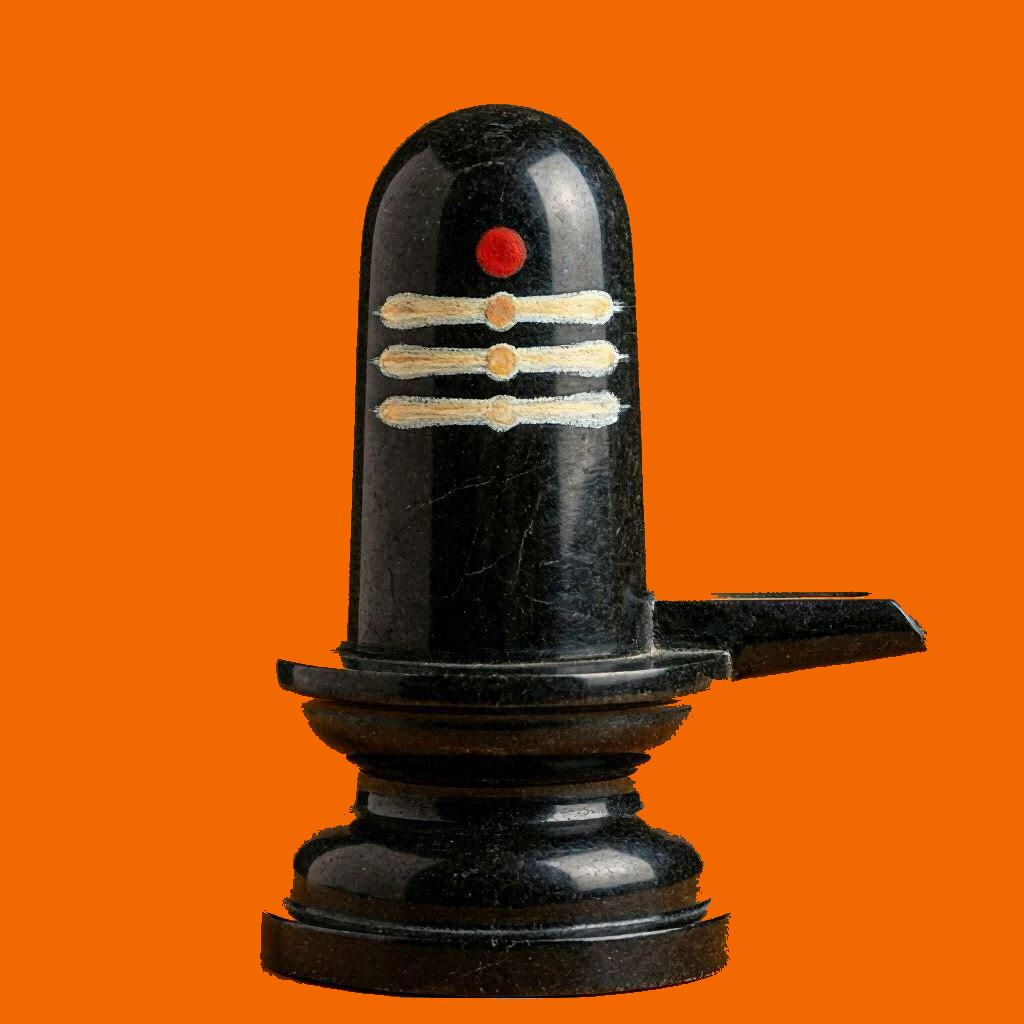
If you have learned about the Shiva lingam from an English-language source written before about 2010 — a museum placard, an undergraduate textbook, a travel guide, an encyclopaedia entry — there is a reasonable chance you were told it is a phallic symbol. That reading is so widespread that even devout Hindus, when asked to explain the lingam to a foreign visitor, sometimes fall back on it apologetically.
It is also, by the standards of the canonical Shaiva texts that the lingam belongs to, wrong. Not partially wrong. Wrong in the way that translating cathedral as “tall stone” is wrong — you have captured a description and missed the thing.
This essay is for anyone who has stood in front of a lingam at a temple — perhaps at Somnath, perhaps at Mahakaleshwar, perhaps at the back of a roadside shrine — and felt that the dominant explanation in books did not match what they were standing in front of. It is also for the practitioner who simply wants the textual ground beneath their daily Om Namah Shivaya firm.
The etymology problem
The Sanskrit word liṅga (लिङ्ग) has a precise philosophical meaning that long predates its use for the Shaiva icon. In Patanjali’s Yoga Sutras, in the Sankhya Karika, in the Nyaya Sutras, linga means “sign,” “mark,” “characteristic,” or “indicator” — that by which something is known. In logic, linga is the hetu — the reason or evidence that lets you infer a conclusion. Smoke is the linga of fire. Wet ground is the linga of rain.
This is the meaning the Shaiva canon inherits and uses. A Shiva lingam is the sign of Shiva — the formless made just-formed-enough to be approached, to be poured over, to be sat in front of. It is the indicator by which the unmanifest is met by a worshipper who lives in the manifest.
The phallic reading is a downstream interpretation that the texts themselves treat as a literal mistake. Adi Shankara, in his Brahma Sutra Bhashya, explicitly addresses worshippers who think the lingam refers to anatomy and corrects them. The Linga Purana, which is the canonical exposition of the form, opens with a long argument that the lingam is aprakrita — non-material, beyond the elements — and that anyone who reads it anatomically has confused the upadhi (limiting form) with the adhishthana (ground).
This is not a modern apologetic. It is the position of the source texts from the moment they were composed.
What the Linga Purana actually says
The Linga Purana — the most authoritative text on the form — gives an origin story that anyone who has stood at Tiruvannamalai at sunset will recognise.
Vishnu and Brahma, in the early hours of a kalpa, fall into an argument about which of them is supreme. As they argue, a column of light appears between them — beginningless, endless, vertical, brilliant beyond seeing. They agree that whoever can find the column’s source — its top or its bottom — is the true supreme.
Vishnu takes the form of a boar and tunnels downward for a thousand years. Brahma takes the form of a swan and flies upward for a thousand years. Neither finds an end. The column has no top and no bottom. It is the jyotir-linga — the sign of light — and what it indicates is the limitlessness that they were arguing about being able to circumscribe.
Shiva, eventually, emerges from within the column — the form within the formless, the sign manifesting from the signified — and they understand.
Every Shiva lingam at every temple in India is, doctrinally, a representation of this jyotir-linga of the origin story. The cylindrical form is the column. The fact that you cannot see its top or its bottom — because it disappears into the yoni-pitha base below and tapers above — is the entire point. The lingam is iconography of limitlessness made small enough to be met.
When you stand in front of a lingam, the form you are looking at is a deliberately reduced symbol of an infinite column of light. The reduction is what makes darshan possible — you could not stand in front of the infinite column of the origin story without being annihilated. You can stand in front of its sign.
The twelve jyotirlingas
The twelve jyotirlingas — the twelve sites where, in tradition, the original column of light manifested in physical form — are the most concentrated expressions of this iconography.
Somnath on the Arabian Sea, Mallikarjuna at Srisailam, Mahakaleshwar at Ujjain, Omkareshwar on the Narmada, Kedarnath in the Garhwal, Bhimashankar in the Sahyadri, Vishwanath at Kashi, Trimbakeshwar at the source of the Godavari, Baidyanath in Jharkhand, Nageshwar in Gujarat, Ramanathaswamy at Rameswaram, and Grishneshwar near the Ellora caves.
The doctrine is that each of the twelve was, at its origin, a svayambhu (self-manifest) lingam — not carved, not installed, not consecrated by a priest, but appeared. The historical reality is more complicated — many of the current lingams at these sites are replacements after destruction across centuries — but the doctrinal claim survives the historical disruption. The site is the jyotirlinga even when the physical lingam has been rebuilt.
This is why the twelve are considered the most powerful darshan destinations in the Shaiva tradition. They are the sites where, in the origin story, the formless took the most direct possible form.
Three components, three meanings
A complete temple lingam usually has three visible components.
The lingam proper — the vertical cylindrical form, usually with a slightly rounded top. This is the brahma-bhaga (Brahma portion) in the iconographic terminology, representing the manifest universe and the act of creation. It is what you offer water to, what you anoint with bhasma, what you garland with bilva.
The yoni-pitha — the horizontal base, often with a channel that lets water flow off the lingam after abhishekam. The word yoni in Sanskrit means “source,” “origin,” “womb,” or “matrix” — the ground from which something arises. In Shaiva metaphysics, the yoni-pitha represents Shakti, the dynamic principle, the energy without which manifestation cannot occur. The lingam without yoni is incomplete; the yoni without lingam is incomplete. The two together are the iconographic expression of Shiva-Shakti as inseparable.
The yoni-pitha is also, in the iconographic tradition, the pedestal in the way a mountain peak rests on a mountain. The relationship is structural, not anatomical. Western readings collapsed both elements into anatomy. The canon does not.
The pranala — the water channel running off the yoni-pitha, almost always oriented north. This is the outflow by which whatever you have offered — water, milk, panchamrita, bilva water — returns to the world rather than pooling in the sanctum. The traditional understanding is that water that has touched the lingam is charged and should not be casually stepped on. Worshippers gather it as theertha (sacred water) at the pranala mouth.
These three together — lingam, yoni-pitha, pranala — are the standard temple form. A few exceptional shrines have variations: the Mahakaleshwar lingam is dakshinamukhi (south-facing), unique among the twelve; the Kedarnath lingam is a natural rock formation, irregular in shape; the Amarnath lingam is made of ice, regenerated each year by the cave’s freezing dew.
Types of lingams
The Shaiva tradition recognises several categories of lingam, distinguished by how they came into being.
Svayambhu lingams — self-manifest. Not carved, not consecrated by ritual, but appeared. The twelve jyotirlingas are the canonical svayambhu. Many less-famous shrines also have svayambhu lingams — usually distinguished by their irregular natural shape.
Manusha-pratishtha lingams — installed by human ritual. The vast majority of temple lingams fall in this category. A stone is shaped by a sculptor, consecrated by prana-pratishtha (life-installation ritual), and becomes the lingam of that shrine. The doctrinal claim is that the consecration ritual draws the same indicating presence into the new form.
Banalingas — naturally polished oval stones from the bed of the Narmada river, traditionally considered svayambhu without need for further consecration. Many household shrines have a banalinga rather than a temple-style installed lingam.
Sphatika lingams — made of clear quartz crystal, traditionally used in personal worship and in shrines where the practitioner wants to see through the lingam (the symbolism of clarity, transparency, the formless made visible).
Parad lingams — solidified mercury, technically demanding to produce, considered to have specific tantric properties. Rare and expensive.
Ice lingams — at Amarnath, the lingam is a regenerating ice column in a Himalayan cave. The pilgrimage exists because the form is impermanent — present each year, then melted, then re-formed.
The variation is part of the doctrine. The lingam is a sign, not a fixed object. The sign can manifest in any medium that lets the worshipper stand in front of formlessness without being lost in it.
The pancha-bhoota-sthalams
Five South Indian temples are organised around the doctrine that the lingam at each represents Shiva as one of the five elements. This is the pancha-bhoota-sthalam circuit, and it is one of the most theologically articulate uses of the lingam iconography in any tradition.
Chidambaram — the lingam of akasha (ether/space). The sanctum is famously empty. You do darshan of a space, not a stone. The doctrine is that the most fundamental manifestation of the formless is the form of empty space itself.
Sri Kalahasti — the lingam of vayu (air). The lamp in the sanctum flickers continuously, evidence of the elemental presence.
Tiruvannamalai — the lingam of agni (fire). The mountain itself is considered the lingam, and the annual karthigai deepam festival lights a fire on its peak that is visible across the plains.
Tiruvanaikaval — the lingam of appu (water). A natural spring rises within the sanctum and constantly submerges the lingam’s base.
Ekambareswarar — the lingam of prithvi (earth). Made of earth, never bathed in water (which would dissolve it), worshipped with sandal paste instead.
The five together are a complete iconographic statement: the lingam is the form by which the formless meets the five elements that make up everything else.
How to do darshan at a lingam
For the practitioner. The traditional sequence at most temples:
Approach with the right hand free. Carry offerings (bilva, water, flowers, fruit) in the left. The right hand is used for the actual offering and for the anjali (folded-hand gesture) at the doorway.
Pause at the threshold. The doorway between the outer mandapa and the sanctum is a real boundary in the temple’s geometry. The traditional pause is brief — three breaths — and lets you arrive before you arrive.
Offer water first. Plain water, poured over the lingam from a small vessel (gaṇḍūṣa or panchapatra). The Shaiva tradition holds that water-abhishekam alone is sufficient — every other offering is optional. This is why a passing pilgrim with no resources can still do meaningful darshan at any roadside Shiva temple.
Bilva, if available. Three-leafed bilva (bel) leaves are the most beloved Shiva offering. One leaf, dropped on the lingam with the smooth side down, is enough. The Linga Purana lists bilva as the foremost among offerings to Shiva — above even gold or silk.
Chant. Om Namah Shivaya is the universal default. Mahamrityunjaya if you have learned it. The chant is the verbal counterpart of the form-offering — you are placing sound in front of the lingam the way you have just placed water on it.
Stand still and look. This is the actual darshan. The first three steps were preparation. The act itself is just standing in front of the lingam and receiving the sight — letting the sign do its work. The texts call this darshanaṃ paramaṃ japaṃ — sight is the highest form of mantra.
Take theertha at the pranala. The water that has flowed off the lingam is sacred and traditionally taken in three sips, the remainder applied to the head.
Circumambulate, then leave. Pradakshina (clockwise circumambulation) is the closing gesture. At most Shiva temples it is half-circumambulation (ardha-pradakshina) — never crossing the pranala water-channel directly, because the channel carries the consecrated overflow.
The whole sequence takes between three minutes and twenty, depending on temperament and crowd. The traditional teachers emphasise that the duration matters less than the quality of attention.
Why this reading was lost in English
A brief historical note. The phallic reading of the lingam entered English-language scholarship through a specific chain of nineteenth-century orientalists — Monier-Williams, Wilkins, and a few others — who were working from a Victorian theological framework that read any non-anthropomorphic religious form as primitive fertility worship. The reading was applied to the Shiva lingam without consulting Shaiva commentary, and it stuck because it was repeated in the major dictionaries and reference works of the era.
The major Indian Sanskritists of the same period — Bhandarkar, Kane, Radhakrishnan — pushed back consistently. By the mid-twentieth century the academic consensus had shifted. But popular reference works, museum placards, and undergraduate textbooks lag academic consensus by decades, and a Western reader can still, in 2026, encounter the old reading as if it were settled fact.
The Shaiva tradition’s own answer to the question has never been ambiguous. It is in the Linga Purana, in the Shiva Purana, in Adi Shankara, in the practice of every Shaiva tradition from Kashmir Shaivism to Tamil Saiva Siddhanta. The lingam is the sign of the formless. What it indicates is the limitlessness in which the worshipper, by standing in front of it, briefly participates.
A closing image
Stand at Tiruvannamalai on Karthigai Deepam evening. The mountain is the lingam. A fire has just been lit on its peak. Half a million people are looking up at it from the plains around. No one is confused about what they are looking at. They are looking at a sign — a vertical column of light, rising into a sky whose top no one can see. The fire will burn through the night and into the next day. The mountain will continue, as it has, for the geological time it took to put it there.
The icon you stand in front of at the village shrine, with its modest stone cylinder and worn yoni-pitha and slow drip of water from the pranala, is the same sign in domesticated form. The reduction is what makes worship possible. The reduction is not the symbol’s failure — it is the symbol’s whole purpose.
This is the lingam. Not the misreading. The thing itself.
If you have stood in front of a lingam this week and want a daily practice that matches what you saw, the 21-day Sankalpa email course lives at this same threshold — one short reflection a day, mantra audio, and the gentle progression that the tradition is built on.