The opening verse
देवराजसेव्यमानपावनाङ्घ्रिपङ्कजं व्यालयज्ञसूत्रमिन्दुशेखरं कृपाकरम्। नारदादियोगिवृन्दवन्दितं दिगम्बरं काशिकापुराधिनाथकालभैरवं भजे॥
In IAST:
Deva-rāja-sevyamāna-pāvanāṅghri-paṅkajaṃ vyāla-yajña-sūtram-indu-śekharaṃ kṛpākaram, nāradādi-yogi-vṛnda-vanditaṃ digambaraṃ kāśikā-purādhi-nāthaṃ kāla-bhairavaṃ bhaje.
In English:
Whose pure lotus-feet are served by Indra himself, whose sacred thread is the serpent, whose crest is the crescent moon, who is the wellspring of compassion, worshipped by Narada and the yogi-companies, sky-clad — I worship Kalabhairava, the lord of the city of Kashi.
The architecture
The Kalabhairava Ashtakam is a tightly built hymn in the same panchachamara metre as the Shiva Tandava Stotram — eight feet per line of rolling alternation, well-suited to recitation at moderate speed. Eight verses, each closing with the same fixed refrain.
The architecture is identical to other Shaiva ashtakams (eight-verse hymns): each verse takes the deity from a different angle and the refrain at the end gathers them all into the same single act of bowing. What distinguishes the Kalabhairava Ashtakam is the specific local-deity framing — every refrain anchors Kalabhairava as the lord of Kashi, not as a generic fierce form of Shiva. This is a hymn embedded in a specific city.
| Verse | Kalabhairava as |
|---|---|
| 1 | Served by Indra, serpent-girdled, moon-crested, compassion-source, naked, lord of Kashi |
| 2 | The forehead-eye that burns sin, the destroyer of dukha, the trident-bearer |
| 3 | The bestower of boons to devotees, the slayer of those who oppose dharma |
| 4 | The one who delights in the burial-grounds, the consort of the dark goddess |
| 5 | The lord of yogis, the bestower of liberation in Kashi itself |
| 6 | The pure consciousness, beyond cause, the witness of all action |
| 7 | The leader of the ghost-companies, the rider of the black dog |
| 8 | The closing benediction — the fruits of recitation |
Kalabhairava and Kashi
To understand this hymn it is essential to understand the Kashi tradition into which it speaks. Varanasi (Kashi) is, in classical Shaiva theology, not merely an important city but the city of liberation. The Skanda Purana, the Kashi Khanda, and many other sources hold that anyone who dies within the prescribed limits of Kashi receives moksha — liberation from the cycle of rebirth — directly from Shiva, who is said to whisper the Tarakam Mantra into the dying person’s ear.
But this raises a theological problem: if anyone who dies in Kashi gets liberation, the city would become a magnet for the unworthy, and the entire Shaiva framework of karma-and-merit would collapse. The solution, in the Puranic narrative, is Kalabhairava. Shiva appoints Kalabhairava as the city’s constable. When a soul dies in Kashi, Kalabhairava examines its karma and decides what punishment must be discharged before the liberation can take effect. The liberation itself is unconditional, but the punishment (which can take many lifetimes worth of suffering, compressed into the moment of dying) is rigorously applied.
This is why pilgrims to Kashi visit the Kalabhairava temple first, before approaching the main Kashi Vishwanath shrine. They are presenting themselves to the city’s constable, who decides whether and how they are to enter. The Kalabhairava Ashtakam is the hymn one recites in this moment of presentation. It is, in effect, the introduction-letter to the kshetrapala.
Why this hymn matters outside Kashi
For practitioners who will never visit Kashi physically, the Kalabhairava Ashtakam still has weight. In the broader Shaiva tradition Kalabhairava is understood as the inner guardian — the consciousness that examines the practitioner’s own actions and applies the punishment of suffering when those actions are out of alignment with dharma. He is not external; he is the conscience itself.
To worship Kalabhairava in this frame is to bow to the part of one’s own awareness that judges. It is to accept the inevitability of consequence. And — crucially — to ask that the consequences come with the speed and intensity of Kalabhairava’s mercy, rather than dragged out across lifetimes. The fierce one is, in this reading, the swift one. The petition is for acceleration, not for escape.
Kalashtami — the canonical occasion
The eighth day after every full moon (called Kalashtami or Bhairava-ashtami) is sacred to Kalabhairava. Twelve times a year, the calendar offers this occasion. The Kalabhairava Ashtakam is the canonical hymn for the day, often recited at twilight (the time when boundaries are porous and Kalabhairava is held to be most active).
The greatest Kalashtami of the year falls in the month of Margashirsha (roughly November-December) and is called Kala Bhairava Jayanti — the day of Kalabhairava’s manifestation. Many Kashi devotees make a point of visiting the Kalabhairava temple on this day, fasting, and reciting the Ashtakam multiple times.
On reciting it well
The metre is the same long rolling panchachamara as the Shiva Tandava Stotram, but the tone is different. The Tandava is exuberant — the dance of intoxication. The Kalabhairava Ashtakam is solemn — the salute to the constable. Both should be sung at a steady moderate pace, but the Kalabhairava Ashtakam wants more gravity. Imagine the chanter approaching a fierce guardian; the cadence is respectful, not exhilarated.
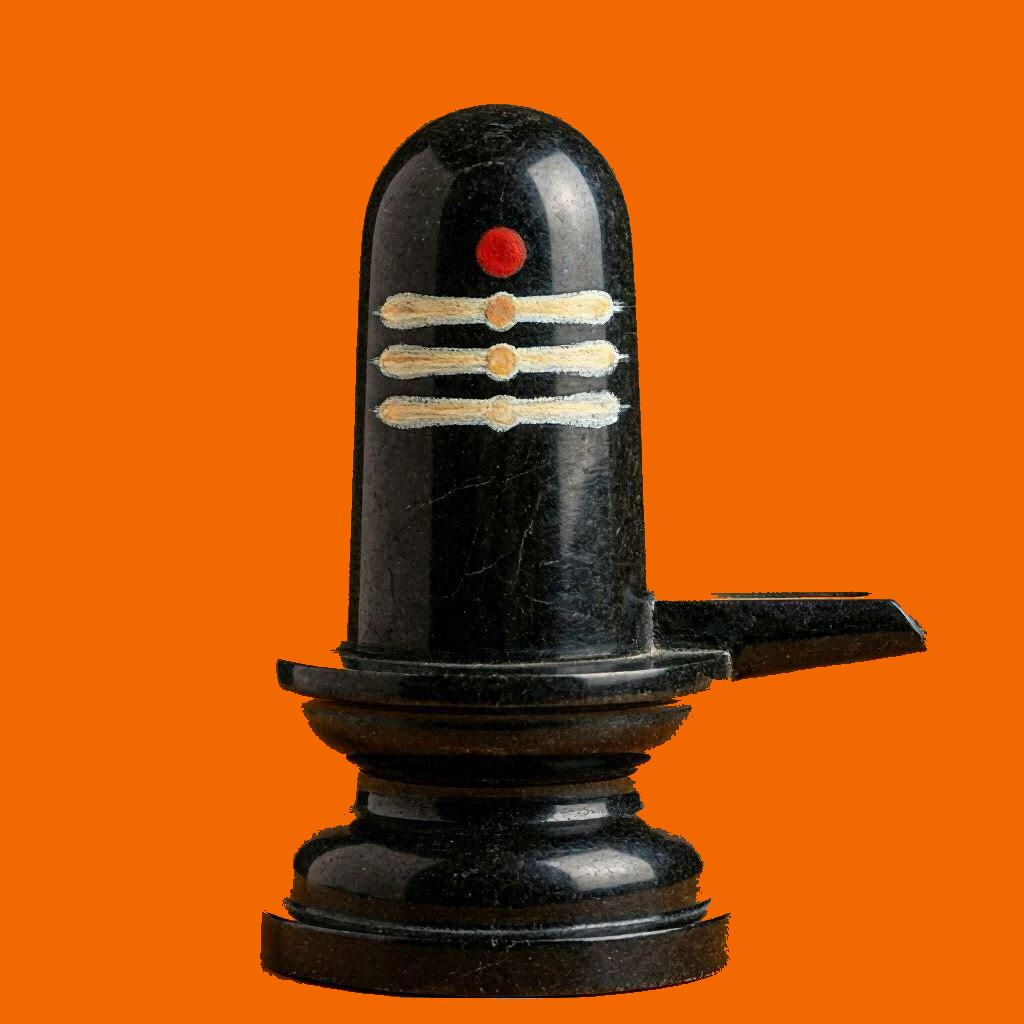
Many practitioners pair the hymn with black sesame (til) offerings or with a small black-stone Bhairava image. Some traditions hold that a black dog is the most appropriate offering one can make on Kalashtami — feeding a stray black dog is considered a direct offering to Kalabhairava.
When to recite
- Kalashtami (eighth day after every full moon, twelve times a year)
- Daily morning practice, especially for those who travel often
- Before journeys, as the traditional fear-petition
- In moments of fear or threat, alone or with others
- When visiting Kashi, before approaching the Kashi Vishwanath shrine
Practice
The Kalabhairava Ashtakam has a particular usefulness for practitioners who struggle with anxiety, fear, or persistent feelings of being unprotected. The hymn does not offer a softer Shiva. It offers Shiva precisely as the one whose fierceness handles the practitioner’s fear. The logic is asymmetric: a soft deity cannot dispel anxiety because anxiety is itself a strong force; only a stronger deity can. Kalabhairava is what the strong deity looks like.
For a beginner: read the hymn through twice with the English alongside. Then learn the refrain (kāśikā-purādhi-nāthaṃ kāla-bhairavaṃ bhaje) — it will close every verse and is the anchor. Add a verse a day across eight days. By the second week the hymn is in the body and can be recited as the closing of any difficult day.