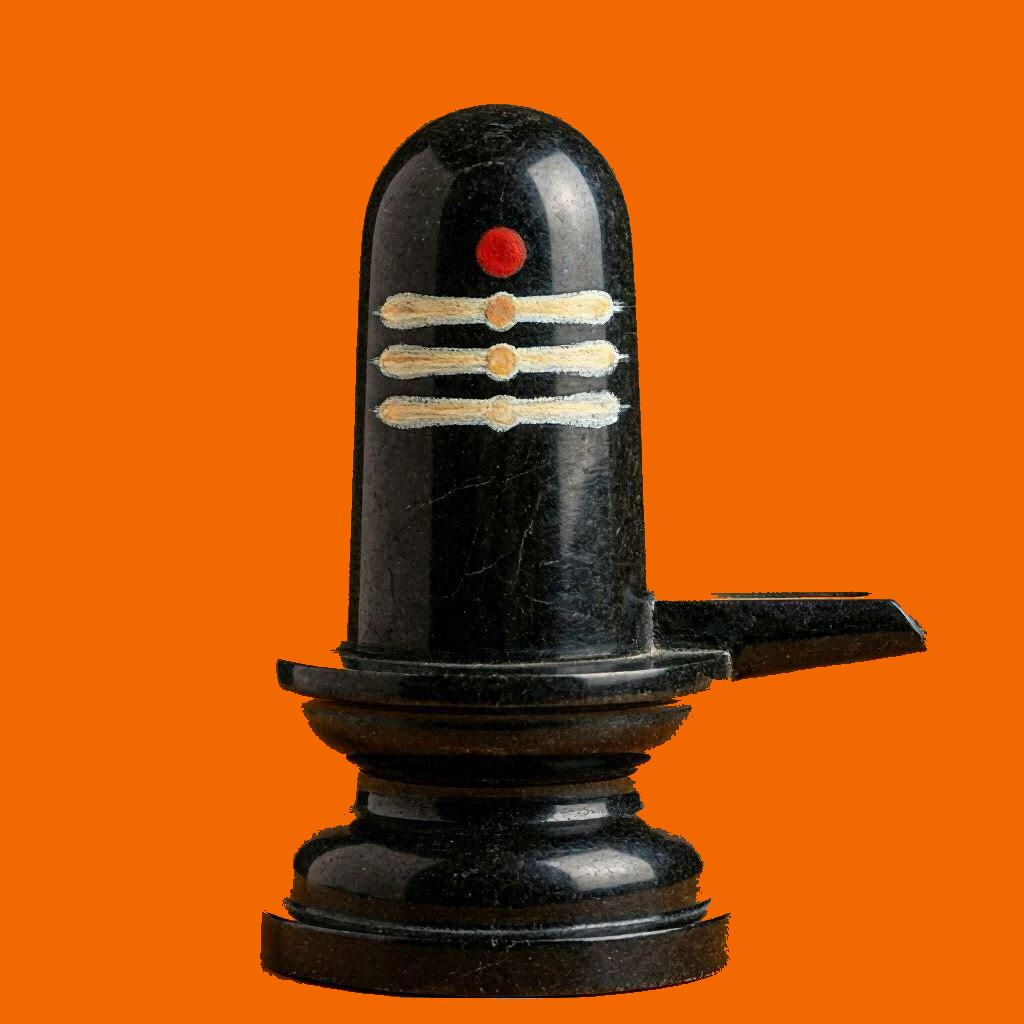
The opening verse
जटाटवीगलज्जलप्रवाहपावितस्थले गलेऽवलम्ब्य लम्बितां भुजङ्गतुङ्गमालिकाम्। डमड्डमड्डमड्डमन्निनादवड्डमर्वयं चकार चण्डताण्डवं तनोतु नः शिवः शिवम्॥
In IAST:
Jaṭā-ṭavī-galaj-jala-pravāha-pāvita-sthale gale’valambya lambitāṃ bhujaṅga-tuṅga-mālikām, ḍamaḍ-ḍamaḍ-ḍamaḍ-ḍaman-ninādavaḍ-ḍamarvayaṃ cakāra caṇḍa-tāṇḍavaṃ tanotu naḥ śivaḥ śivam.
In English (approximate — the rhythm cannot be carried over):
From the forest of his matted locks the sacred river streams, sanctifying the ground beneath. About his throat hangs the tall garland of the serpent-king. Damat damat damat daman — the damaru sounds — and Shiva does the fierce tandava. May that Shiva extend to us all that is auspicious.
The dance the hymn enacts
The Shiva Tandava is unique among Shaiva hymns in that the form of the poem is the content of the poem. Most stotras describe their deity. This one performs its deity. The metre — panchachamara, eight feet of light-heavy alternation per line — produces, when sung at the proper pace, a galloping cadence that is literally the rhythm of the tandava.
Note the third line of the opening verse: ḍamaḍ-ḍamaḍ-ḍamaḍ-ḍaman. That is not poetry describing the sound of Shiva’s damaru. That is the sound of Shiva’s damaru, in Sanskrit syllables, embedded in the poem. The composer has done what only Sanskrit phonology can do — encode the percussion of the deity directly into the recitation.
The story behind the attribution
Tradition associates the hymn with Ravana, the asura king of Lanka and a formidable Shiva-bhakta in the Puranic-Ramayana frame. The story varies in detail across regional traditions, but the canonical narrative runs:
Ravana, intoxicated by his own strength and devotion, attempted to lift Mount Kailasa — Shiva’s mountain abode — to carry it back to Lanka. Shiva, seated atop the mountain with Parvati, pressed his toe gently on the summit. The mountain settled, pinning Ravana’s arms beneath it. In agony and humiliation, Ravana sang — and the song he composed in that crushing moment is the Shiva Tandava Stotram. Hearing it, Shiva was so moved by the technical brilliance and the depth of bhakti that he lifted the mountain and granted Ravana boons.
Whether the historical Ravana (if any) actually composed it, or whether tradition assigns authorship to him for theological reasons — a devil who composes the most beautiful Shiva hymn establishes that Shiva accepts devotion from any direction — is a question philology cannot settle. What matters in practice is that the hymn has been sung in Ravana’s voice for many centuries. Some practitioners imagine the asura’s pinned-arms agony each time they sing it; the intensity of the recitation owes something to that imagined frame.
The architecture across sixteen verses
| Verse | What it celebrates |
|---|---|
| 1 | The opening tandava — matted locks, Ganga, serpent, damaru |
| 2 | The Ganga in his hair, the fire in his forehead, the half-moon |
| 3 | Parvati at his side, the desire that arises and is burnt away |
| 4 | The dust of his dance perfuming the directions |
| 5 | The blue-throated one (Nilakantha — who drank the poison) |
| 6 | The forehead-fire that burnt Kama (god of desire) |
| 7 | The matted locks again, the moon as ornament |
| 8 | Praise — when, when shall I worship him in earnest? |
| 9 | The cremation-ground dance, the auspicious in the inauspicious |
| 10 | The forest of matted locks — returned to and elaborated |
| 11 | The moon-ornament, the serpent-ornament, the ash-ornament |
| 12 | When shall I be free, my hands placed at his feet? |
| 13 | The third eye, the burnt one (Kama again, dissolved) |
| 14 | The poison-throat, the ash-smeared body |
| 15 | The closing benediction — the phala-shruti, the fruit of recitation |
| 16 | The traditional sign-off (some manuscripts omit) |
The structure is not strictly linear. The hymn returns to its central images — hair, Ganga, moon, serpent, ash, third eye — at multiple angles, the way a dance returns to certain figures across its development. By the end the chanter has been turned, by the metre as much as by the content, through every face of the tandava.
On reciting it well
This hymn punishes timidity. Sung quietly and slowly, it feels overlong and strange. Sung at proper speed with the metre held firmly — the damaḍ-ḍamaḍ syllables crisp, the eight feet per line undivided — the hymn rises into a recognisable trance state. Many traditional reciters use the damaru themselves while singing, or sing alongside a tabla locked to the metre.
For a beginner: do not start with the full hymn. Take one verse (the opening is canonical), repeat it daily for a fortnight until the rhythm is internal, then add verse two. Many practitioners take a year to learn all sixteen and consider that pace appropriate. The hymn is not a checkbox.
When to recite
The canonical occasions are:
- Maha Shivaratri — once a year, at one of the four watches of the night
- Pradosham — twice a month, at the twilight intensity that suits the hymn
- Personal practice — when the practitioner needs to break through stagnant devotion and meet Shiva at higher temperature
The hymn is not for soothing. It is for moving. Pair it across the week with calmer companions — Lingashtakam, Rudrashtakam — so that practice has both registers available.
A final note
The closing benedictory verse (phala-shruti) — the fifteenth or sixteenth, depending on the manuscript — promises specific fruits to those who recite the hymn at dusk: prosperity, beauty, fame, and ultimate devotion to Shiva. We pass on the promise without endorsement. The deeper fruit, in our editorial reading, is the one the hymn delivers in the act of recitation itself: the chanter, for the duration of the eight minutes, is no longer chanting about the dance. The chanter is, in some small way, part of it.