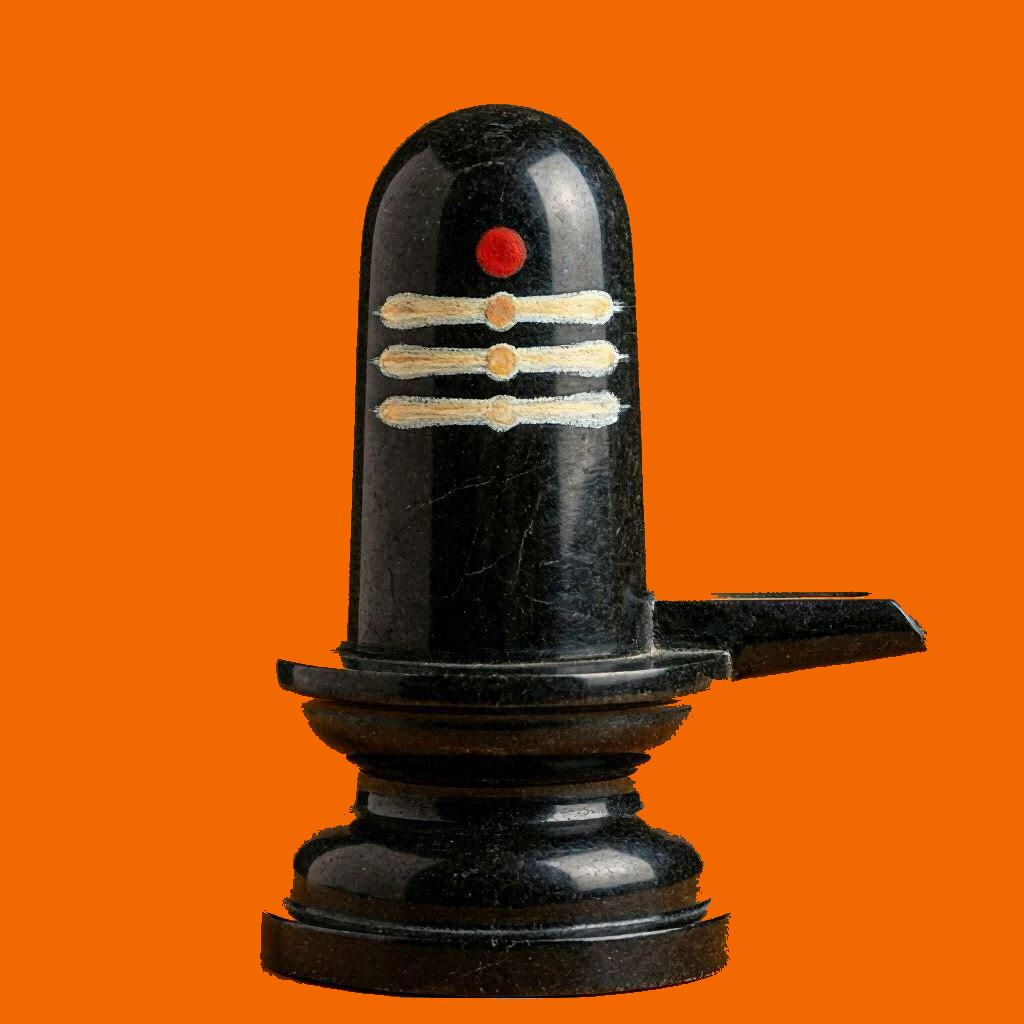
The bilva leaf is the most reliable offering in Shaiva ritual. Lotus is offered to Lakshmi, tulsi to Vishnu, hibiscus to Devi — and bilva to Shiva. If a serious Shaiva had to keep only one ritual gesture across the year, the simple offering of a fresh bilva leaf on the linga, with full attention, would be enough.
This is the leaf whose significance most practitioners learn early but whose details most learn slowly. This essay walks through what it is, why the tradition gives it the place it does, and the small practical rules for offering it correctly.
What bilva is
Bilva (Sanskrit bilva or bilwa, Hindi bel, Tamil vilvam or koovilam, botanical Aegle marmelos) is a deciduous tree native to the Indian subcontinent. It grows widely from the foothills of the Himalayas down to the southern tip of Tamil Nadu, and across most climates in between.
The tree’s defining feature for Shaivas is the leaf: each bilva leaf is trifoliate — three small leaflets growing from a single stem. The three leaflets are traditionally read as Shiva’s three eyes, the three gunas (sattva-rajas-tamas), the three forms of time (past-present-future), and the trident itself.
The tree also produces a hard-shelled fruit (often called bel fruit) which is sometimes pulped and offered alongside the leaves at major Shaiva ceremonies. The fruit is medicinal — long-recognised in Ayurveda as a digestive — but for ritual purposes, the leaf is primary.
Why bilva, specifically
Several reasons traditionally given, all worth knowing:
Cooling: bilva is held to be a shitala (cooling) plant. Shaiva theology repeatedly emphasises that Shiva’s nature is hot — the fire of asceticism, the heat of the trident, the burning ground of Kashi. Offering a cooling leaf to the heated deity is a complementary act: the seeker brings what the deity does not naturally have, and the offering is therefore meaningful.
Three-in-one: as noted above, the trifoliate structure mirrors much of Shiva’s symbolic register. A single leaf is, in this reading, already a full offering — the three eyes, the trident, the threefold time all enclosed in one small green form.
Always available: unlike seasonal flowers, bilva trees produce leaves year-round across most of India. The tradition emphasises that a true offering should be available to the daily practitioner whether they can afford rare flowers or not. Bilva is the democratic offering — affordable, accessible, persistent.
Puranic narrative: the Shiva Purana contains several stories of devotees who offered nothing but bilva leaves through years of practice and received Shiva’s full grace. The most famous is the hunter Kannappa Nayanar (a south-Indian Shaiva saint) whose devotion was so complete that his rough bilva offerings — gathered without ritual purity, sometimes with leaves chewed in his mouth to test them — were accepted above the formal offerings of the Brahmin priests. The story makes the same point in narrative form that the cooling logic makes in theological form: the leaf’s value is in the devotion behind it, not in the ritual elaboration around it.
The rules for offering
Tradition has accumulated a small set of rules across centuries. None are absolute; all are worth knowing.
Selection
- Three leaflets: a proper bilva offering is a complete trifoliate cluster, not a single leaflet detached from its companions.
- Whole and unbroken: torn or insect-eaten leaves are traditionally not offered, though a single tear is not considered disqualifying.
- Fresh, not wilted: the leaf should be plucked recently. The traditional preference is morning-plucked leaves used on the same day, but bilva keeps for 24-48 hours in a cool place if necessary.
Plucking
- Pluck respectfully. Do not break branches. Pluck only the number of leaves you actually need.
- Do not pluck on certain days: tradition specifies Mondays, the chaturdashi (14th lunar day), the ashtami (8th lunar day), and during eclipses are days when plucking is avoided. The leaves needed for those days should be plucked the day before.
- Acknowledge the tree with a small gesture before plucking. The tree itself is held as sacred — a vrikshadevata (tree deity) dwells in mature bilva trees.
Offering
- Wash the leaf in clean water before offering. Even fresh-plucked leaves carry dust.
- Place leaf flat on the linga, smooth (upper) side DOWN — this is the traditional orientation. The reasoning: Shiva is symbolically beneath; the leaf rests its underside (the side that faced the earth on the tree) on the linga.
- A single leaf is sufficient. Many practitioners offer 21 leaves or 108 leaves for elaborate rituals, but the tradition is clear: even one leaf, offered with full attention, is a complete offering.
- Do not reuse. A bilva leaf offered on the linga is not used again. After the puja closes, the leaves can be released into a flowing river, buried, or left at the base of a tree.
What to avoid
- Cut leaves with scissors or knives are traditionally not offered. The leaf should be plucked by hand.
- Leaves from the ground that have already fallen are also traditionally not offered. The leaf should be plucked from the tree.
- Leaves on Mondays specifically: while Monday is Shiva’s day of the week, the tradition is that bilva should not be PLUCKED on Mondays (it can still be OFFERED on Mondays from a previous day’s plucking). The reasoning is that the bilva tree is itself in repose on Mondays.
These rules are honoured by serious practitioners but not enforced as conditions of validity. A practitioner who plucks a leaf on a Monday morning and offers it that evening has not failed Shiva; they have simply not honoured a tradition some others honour. The substance of the offering is the devotion.
Sourcing bilva in the diaspora
For practitioners outside the subcontinent, fresh bilva is harder to find. Three approaches:
-
Grow a bilva tree at home. Bilva is hardy and grows in most subtropical climates. Seedlings are available from Indian-plant nurseries in the US, UK, Australia. Most need a warm spot and consistent water for the first two years; after that they tolerate a wide range of conditions. A home bilva tree is the cleanest long-term solution.
-
Dried bilva leaves from Indian grocery stores. Most well-stocked Indian markets carry packets of dried bilva for puja. These are less ideal than fresh but are completely valid offerings; the tradition permits dried leaves when fresh is unavailable.
-
Substitute mentally during the offering. This is the Shaiva-Tantric Manasa Puja approach — see Shiva Manas Puja for the full hymn. If no leaf is available, offer the leaf mentally, visualising it placed on the linga while reciting the mantra. The tradition is explicit: a mentally-offered leaf with full attention is acceptable as a real-leaf offering. This is the option for practitioners with no access to physical bilva, on travel, or in any context where the physical offering is impossible.
The mantra for the offering
While placing the leaf, the canonical mantra to recite is the Bilvashtakam — the eight-verse hymn specifically composed for the bilva offering. Each verse names a quality of the bilva leaf and dedicates it to Shiva.
The opening verse:
त्रिदलं त्रिगुणाकारं त्रिनेत्रं च त्रियायुधम् । त्रिजन्मपापसंहारं एकबिल्वं शिवार्पणम् ॥
In English:
Three-leafed, embodying the three gunas, with three eyes, three weapons; destroying the sins of three lifetimes — one bilva, I offer to Shiva.
The Bilvashtakam takes about 2 minutes to recite completely. A practitioner who offers bilva on every Pradosham (twice a month) and on every Monday morning recites the Bilvashtakam roughly 75 times a year — which is enough repetition to memorise it within the first year.
A practical close
The bilva offering’s simplicity is its discipline. Three leaves on one stem, washed in water, placed flat on the linga (or on the image, or in the mind), with the Bilvashtakam if you know it or with Om Namah Shivaya if you do not. Two minutes of practice. The most reliable Shaiva offering there is.
If you have a linga at home and a bilva source nearby — even a single leaf, offered with attention on a Monday morning — you have completed the most central daily ritual of the Shaiva tradition. Whatever else gets added is good, but it is built on this.
If you are far from any bilva tree, the Shiva Manas Puja gives you the mental-offering version that the tradition holds as equally valid. Read it once a week and the practice continues regardless of geography.
The leaf is small. The discipline it carries is not.
Om Namah Shivaya.