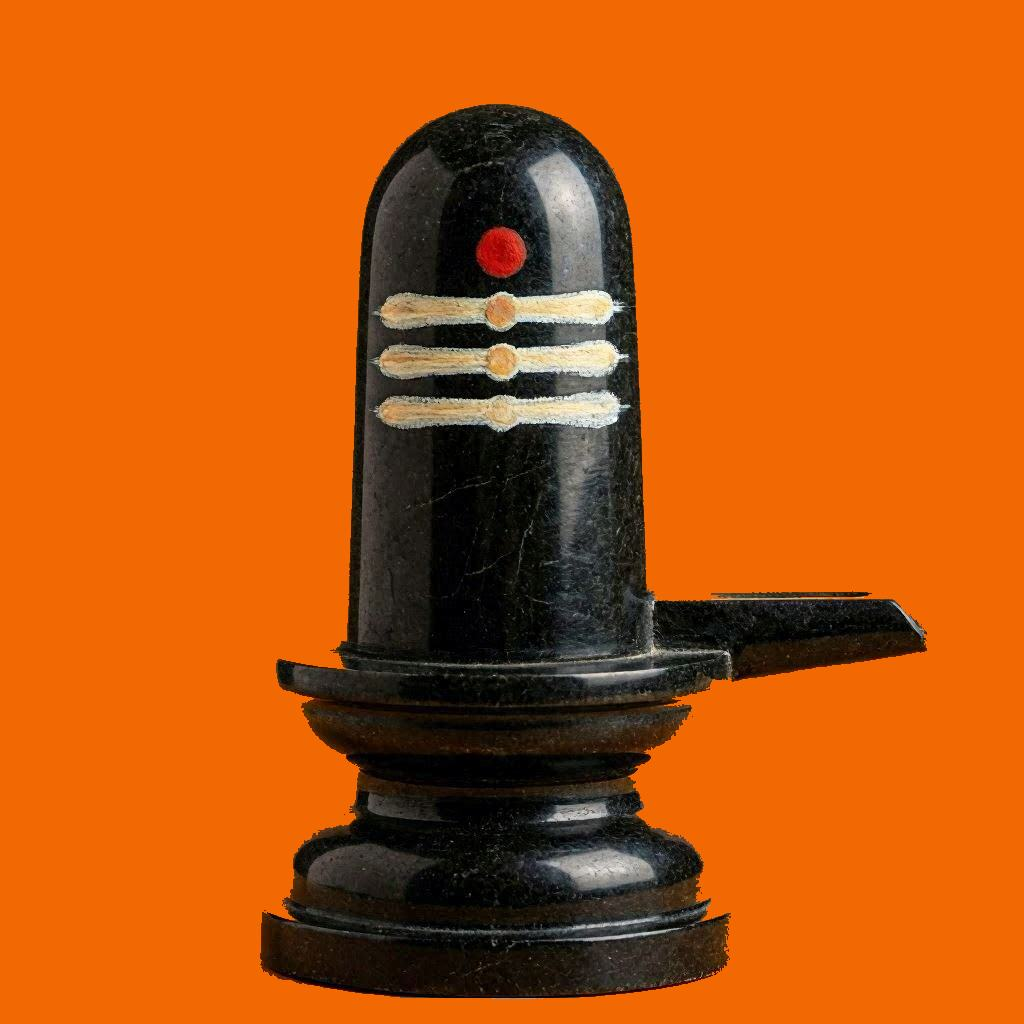
Walk up to any Shiva temple in India and you meet Nandi before you meet Shiva. The bull sits in the open hall or on a plinth in the courtyard, forelegs folded, head lifted, facing the sanctum. He is not decorative and he is not incidental. In a tradition that arranges everything with intent, the first thing placed on the axis between you and the deity is an animal who is already looking where you are about to look.
Most practitioners learn one sentence about him — Shiva’s vahana — and stop. The sentence is not wrong, but it is the least interesting true thing about Nandi, and it arrived later than people assume. What follows is what the tradition actually holds, where the popular customs come from, and how to do darshan at a Nandi properly.
The name
Nandi comes from the Sanskrit root √nand, to rejoice, to delight, to be glad. The name is not a description of a bull. It is a description of a state: the one who is delighted, or the one in whom there is joy.
This matters for reading the icon. Nandi is not depicted straining, labouring, or waiting to be mounted. He is seated, settled, entirely at rest, with his attention fixed. The name and the posture say the same thing — that the completed devotional state is not effortful. It is contentment with the gaze already turned in the right direction.
Bull first, mount second
The popular account runs: Shiva needed a vehicle, and Nandi is that vehicle. The scholarly and textual picture is more layered, and worth knowing because it changes what the icon means.
The bull — vrishabha — is associated with Shiva very early, and the earliest associations are emblematic rather than vehicular. The bull appears as Shiva’s sign, his banner (vrishabha-dhvaja, “he whose banner is the bull”), an attribute belonging to the deity in the way the trident and the crescent belong to him. Shiva is called Vrishabhanatha and Vrishabhavahana, and the epithets are not synonyms: one makes the bull his, the other makes the bull his conveyance.
Alongside this runs a second stream, in which Nandikeshvara (or Nandin) is a distinct being — a figure of the Shaiva retinue, often shown in human or part-human form, who serves as Shiva’s gatekeeper, the chief of the ganas, and, importantly, a teacher.
Over centuries these streams converge, and the seated bull outside the sanctum comes to carry both sets of meaning at once: the emblem of Shiva, and the person of his foremost devotee. The reason to hold both readings rather than collapse them into “vahana” is that they explain different things about the icon. The emblem reading explains why the bull is there at all. The devotee reading explains why he is facing inward.
The gaze is the whole point
Every element of a Nandi image is arranged around the direction of his attention. He is placed on the temple’s central axis, aligned to the linga, at a height and angle from which he can see it. In many south Indian temples the alignment is precise enough that a line drawn from Nandi’s eyes passes through the doorway and lands on the deity.
The tradition reads this as instruction rather than decoration. Nandi is the model of what a devotee looks like when devotion is finished: attention that does not wander, does not negotiate, does not periodically check whether anything more interesting is happening elsewhere. He is not waiting for darshan. He is in it, permanently, and has been since before you arrived.
There is a second, sterner reading. Nandi is the dvarapala, the gatekeeper. You do not walk past him; you are admitted. The devotee reaches the deity through the completed devotion of another, which is why the sequence in a Shaiva temple is Nandi first and Shiva second, and never the reverse.
The bull as dharma
Puranic literature gives the bull a further layer: the four legs of the bull are read as the four feet of dharma — commonly given as satya (truth), shaucha (purity), daya (compassion) and dana (charity), though the lists vary by text.
This reading carries a diagnosis of the age with it. In the accounts where it appears, dharma stands on all four legs in the first yuga and loses one in each successive age, so that in the Kali Yuga it balances on one. Placing a four-legged bull at the entrance of the sanctum is, on this reading, a quiet statement about what has to be intact before you approach — and an acknowledgement of how little of it usually is.
Nandi as teacher: the Agamic thread
The strand of the tradition most often skipped is Nandi as transmitter.
In Shaiva Siddhanta’s account of its own lineage, the Agamas — the ritual and theological texts that govern how temples are built, how the linga is installed, how worship is conducted — descend from Shiva himself and pass through Nandikeshvara before they reach human teachers. Nandi is not merely a listener. He is the first student, and then the first guru.
The Nandikeshvara Kashika, a short and much-discussed text on the Maheshvara Sutras (the fourteen aphorisms of Sanskrit phonology traditionally said to have come from Shiva’s drum), is attributed to him. Whatever one concludes about authorship, the attribution tells you the position Nandi occupies in the tradition’s self-understanding: at the join between revelation and instruction.
So the bull outside the sanctum is simultaneously Shiva’s emblem, his gatekeeper, the model devotee, the standing measure of dharma, and the source from which the rules of the very temple you are standing in were received. Very little in that hall is doing only one job.
The whisper: what it is, and what it is not
The custom is familiar across India and strongest in the south: the devotee approaches Nandi, leans toward one ear, cups a hand around the mouth, and whispers a wish, on the understanding that Nandi will convey it to Shiva.
Two things should be said plainly, because they usually are not.
First, it is a real and living custom, and there is nothing foolish in it. It is practised widely, taught by grandmothers, and observed in major temples. The logic behind it is intelligible and consistent with the rest of the tradition: you approach the deity through the one whose devotion is complete, exactly as you enter the sanctum past the gatekeeper. Whispering rather than speaking aloud is generally explained as keeping the wish between you and Shiva — the cupped hand exists so that the person behind you in the queue does not hear it.
Second, it is a temple custom rather than an Agamic injunction. It is not prescribed in the ritual texts that govern Shaiva worship. It is not attested in the older Puranic material about Nandi. It appears to be a devotional practice that grew up around the icon and spread widely, particularly in Tamil Nadu and Karnataka, rather than a rule handed down with the Agamas.
Knowing this should not stop anyone from doing it. It should stop the specific error of treating it as the reason Nandi is there, or of concluding that Nandi’s function is to be a messenger service. The gaze came first, by a very long way. The whisper is a beautiful thing that later devotion built on top of it.
There is also a strand of practice that reverses the emphasis entirely, and it deserves the last word on the subject: rather than asking Nandi to carry a request inward, sit where Nandi sits, look where Nandi looks, and want nothing for the length of that look. Some teachers hold that this is the actual instruction the icon is giving, and that the whisper is the version of it that survives when the instruction is too demanding.
How to do darshan at a Nandi
The etiquette is simple and widely shared, with regional variation.
- Greet Nandi before entering. He is the gatekeeper; the sequence is his hall, then the sanctum.
- Do not stand between Nandi and the linga. This is the one rule almost everyone breaks, usually while taking a photograph. Nandi’s line of sight to the deity is the axis the whole temple is built around, and standing in it interrupts the one thing he is doing. Cross the axis to the side, or behind him, not in front.
- Look at the deity between his horns. In many temples this is the prescribed darshan: you crouch or stand behind Nandi and take the sight of the linga framed by the horns, borrowing his angle. It is the most instructive thing you can do in that hall, and most visitors do not know to do it.
- If you whisper, cover your mouth — the cupped hand is part of the custom, and its point is discretion, not secrecy.
- Touching varies. Some temples permit touching Nandi’s horns or hooves; many large temples do not, and metal or stone icons under daily abhisheka are usually off limits. Watch what local devotees do before reaching out.
- Do not climb on a Nandi, ever, including the very large stone ones that look like monuments. They are consecrated images, not sculpture in a park.
The great Nandis, if you want to see one
- Lepakshi, Andhra Pradesh — a monolithic granite Nandi roughly 4.5 metres tall and 8 metres long, carved from a single boulder, among the largest in India. It sits apart from the temple, facing the shrine’s naga-linga in the distance.
- Brihadeeswarar temple, Thanjavur — the Chola-era complex’s Nandi is a monolith of comparable scale, aligned to one of the tallest vimanas in the country.
- Bull Temple (Dodda Basavana Gudi), Bengaluru — a single-rock Nandi that is itself the presiding image, rather than an attendant to a shrine.
- Chamundi Hills, Mysuru — carved from the living rock on the path up the hill, worn smooth by centuries of hands.
- Nandi Hills, Karnataka — named for the form of the ridge, with a Shaiva temple at its base.
What to take from it
The next time you are in a Shiva temple, do one thing before anything else: stand behind Nandi, at his height if you can, and look at what he is looking at, for longer than is comfortable.
That is the instruction. Everything else in the hall — the emblem, the gatekeeper, the four-legged dharma, the lineage of the Agamas, and yes, the whisper — is commentary on it.