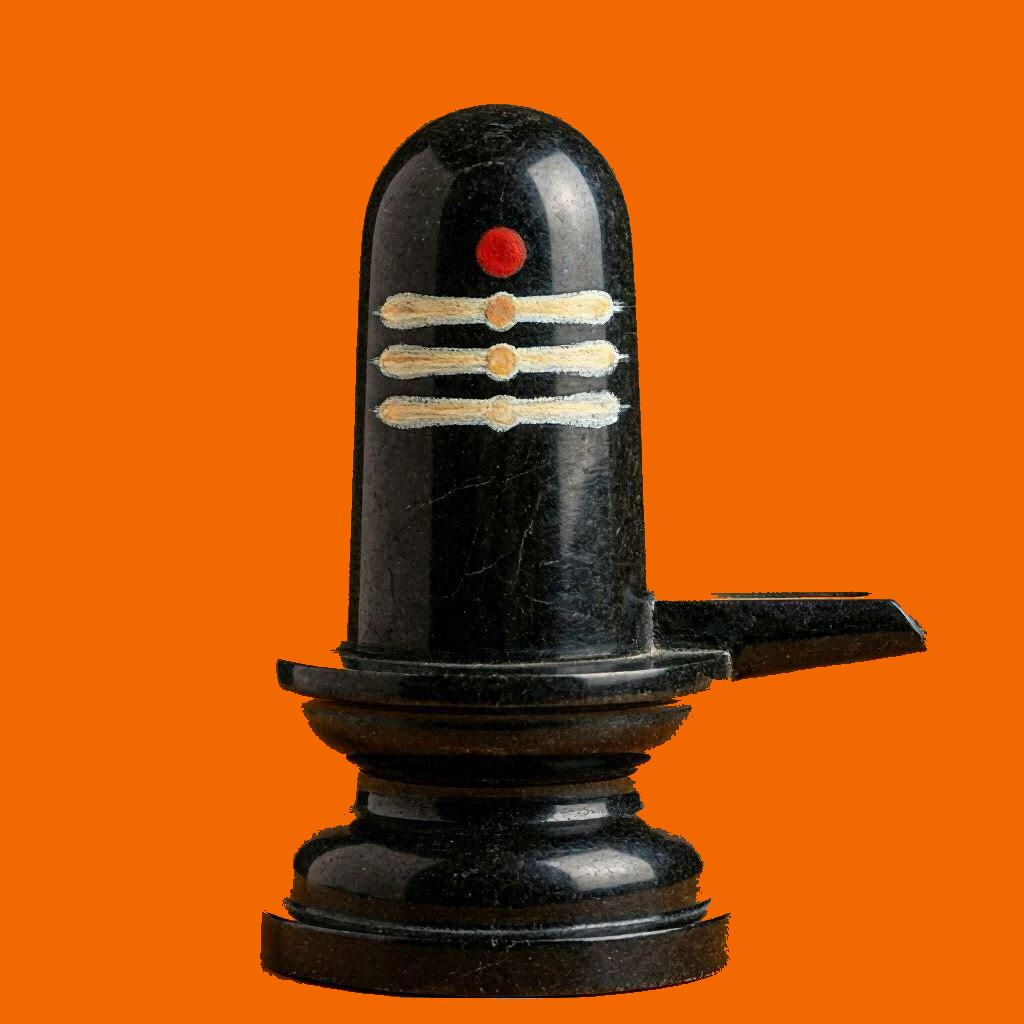
Shiva is the most iconographically dense deity in the Hindu pantheon. Every element of his form carries specific theological meaning, and the meanings have remained remarkably consistent across two thousand years of temple sculpture — from the Gupta-period bronzes to the Hoysala-era reliefs to the contemporary lingas at Murudeshwar and beyond.
This essay walks through the canonical Shiva form, attribute by attribute, with the textual sources for each meaning. By the end, you should be able to look at any Shiva sculpture or painting and read what it is saying.
The standard iconography
The canonical Shiva — the Mahadeva form that appears in the majority of temple sculptures — has these attributes:
- Matted locks (jata) piled on the head
- Crescent moon nested in the locks
- The Ganga flowing from the locks
- Three horizontal lines of ash on the forehead
- The third eye on the forehead
- A snake (or several) coiled around the neck
- A garland of skulls (in fiercer forms)
- The throat blue
- Elephant skin OR tiger skin wrapping the waist
- A trident (trishula) in one hand
- A damaru (small hourglass-shaped drum) in another
- Often a string of rudraksha beads
- Sometimes a kamandalu (water pot) or a skull-cup
- Standing or sitting on the bull (Nandi)
- The matted locks dressed with a snake-belt around the waist
Each element has a specific reading. We will go through them in order from top to bottom.
The matted locks (jata)
Shiva’s hair is not styled, not cut, not oiled. It is piled in matted dreadlocks. This is the universal hairstyle of the vanaprastha and sannyasi — the renunciate orders. By wearing his hair this way, Shiva signals his identity as the ur-sannyasi, the renouncer who has gone before all other renouncers.
But Shiva’s matted locks also serve a specific cosmological function: they hold the Ganga. According to the Puranic story, when the river goddess Ganga was first brought to earth (to wash away the ashes of the 60,000 sons of King Sagara), the force of her descent would have shattered the planet. Shiva caught her in his hair and let her trickle out gradually. The Ganga still flows from Shiva’s hair in this cosmological reading; every drop of the river is a drop he is metering out.
The hair therefore holds two readings simultaneously: the discipline of the renouncer AND the cosmic compassion of the protector. Both are essential.
The crescent moon (chandra)
Above the matted locks, in nearly every Shiva image, sits a small crescent moon. The moon is not a single moon but specifically a five-day-old crescent (bāla candra) — the youngest visible moon after the new moon.
Several readings:
Time-keeping: the moon’s phases are the basis of the Hindu lunar calendar. Shiva wearing the moon on his head means time itself is in his hair. He is the master of cycles; he wears the very meter by which Shaivas measure their festivals.
Cooling: the moon is chandra (cool), Shiva is agni (hot). The crescent on his head is the cooling counter to his inherent heat — the same logic that explains why bilva leaves and water are his preferred offerings.
Soma: in deeper Vedic theology, the moon is soma, the cosmic nectar. Shiva wearing the moon means he carries the source of immortality on his own head. Practitioners reading the iconography this way understand Shiva as the embodiment of the amrita (deathless essence).
Recovery: in one Puranic narrative, the moon was once cursed by his father-in-law Daksha to wane to nothing. Shiva took the dying moon onto his head and held him there until he could recover. Every full moon since then is the moon recovering, every new moon is the moon waning, and Shiva’s head is the resting-place where the cycle continues. The story names Shiva as the protector of what is fading.
The Ganga
A small female figure pours from Shiva’s hair, or the river itself is depicted as a stream. This is Ganga — the river goddess.
The reading is straightforward: Shiva is the source from which the holiest river of India flows. Pilgrims who bathe in the Ganga are, in this framing, being washed by Shiva’s overflow. The Ganga’s water as offering on the Shiva linga is therefore a cyclic gesture — the water that comes from Shiva is returned to Shiva.
The three horizontal lines of ash (tripundra)
Three horizontal lines of vibhuti (sacred ash) are drawn across Shiva’s forehead. This is the tripundra — the universal mark of Shaiva orientation.
Readings:
The three gunas: sattva (purity), rajas (activity), tamas (inertia) — the three modes of all manifest reality. Shiva wears all three openly on his forehead. They are present in him; they are also transcended in him.
The threefold time: past, present, future. The same triple structure.
The ash itself: ash is what remains when everything else has burned. Shiva wearing ash is Shiva wearing the residue of all that has been consumed. The implication: he is what does not burn even when everything else does.
The tripundra is the mark Shaivas wear themselves — the daily forehead application that signals tradition orientation. To wear the tripundra is to be marked as Shiva’s, openly, in the way one would mark a flag.
The third eye (trinetra)
Between the eyebrows, slightly above, sits the third eye. In standard iconography it is often shown as a vertical eye-shape, sometimes closed, sometimes open.
The third eye is the most layered symbol in the Shiva iconography. Multiple readings:
Undistorted perception: the ajña-chakra in the subtle-body theory is the seat of clear seeing — the eye that perceives what is, without the filters of desire or aversion. Shiva’s third eye is the iconographic depiction of this faculty.
The destroying eye: when Shiva opens his third eye in anger, what it falls on is incinerated. The most famous Puranic example is Kama (the god of desire) — when Kama tried to disturb Shiva’s meditation by inducing romantic feeling, Shiva opened the third eye and burned Kama to ash on the spot. The reading: the eye that truly sees is the eye that destroys what cannot survive its sight. Illusion cannot withstand direct perception.
Foreknowledge: in some Tantric readings, the third eye perceives across time. Shiva sees past, present, and future as a single field. This reading is more theologically advanced and not universal across traditions.
In daily practice: when Shaivas close the eyes for mantra meditation, the focal point is typically the space between the eyebrows — the location of the third eye. The iconography is therefore not just a symbol but an instruction: here is where to direct your inner attention.
The snake (naga)
A snake (sometimes several snakes) coils around Shiva’s neck. The most often-depicted snake is Vasuki — the king of serpents.
Readings:
Mastery over kundalini: in subtle-body theory, kundalini is the coiled serpent-energy at the base of the spine. Shiva wearing the serpent at his neck signifies mastery over this energy — the kundalini that has risen to the throat and become his ornament rather than his obstacle.
Mastery over fear: snakes are universally feared. Shiva wearing a snake as a casual garland means snake-energy is no longer a threat to him; what others fear, he wears. The reading extends: a serious Shaiva practitioner aims at a relationship to fear in which the feared object becomes simply present, neither denied nor magnified.
The connection to the Samudra Manthan: when the ocean was churned, Vasuki served as the churning rope. After the churning, Vasuki found his way to Shiva’s neck. Shiva wearing him is the post-cosmological honouring of the snake who served as the cosmos’s first instrument.
The blue throat (nilakantha)
Shiva’s throat is depicted as blue (sometimes vividly so) in many sculptures. The blue is from the halahala — the cosmic poison that was the first product of the churning of the ocean.
When the poison emerged and threatened to destroy creation, the devas and asuras both retreated; only Shiva drank it. Parvati prevented him from swallowing fully by squeezing his throat; the poison stayed trapped there and turned his throat blue. The epithet Nilakantha (“blue-throated”) refers to this event.
The reading: Shiva is the one who consumes what would destroy others. The poison the universe could not survive becomes simply a coloured throat on the deity who could. There is a moral here about what a serious practitioner gradually develops — the capacity to consume difficulty that would crush others, without being destroyed.
The elephant or tiger skin
Shiva wears either an elephant skin (gajacharma) or a tiger skin (vyaghracharma) as a wrap.
Both have Puranic origin stories. The elephant skin was peeled from a demon-elephant Shiva killed. The tiger skin was given by sages who tried to ambush him with a tiger (the tiger turned tame, Shiva killed it, wore it). In both cases the message is the same: Shiva takes the skin of the predator. He does not fear the predator; he wears it.
The skin is also a renunciate’s garment — sannyasis traditionally wear animal skins (now usually saffron cloth instead) as a sign of stepping outside the householder’s woven garments. Shiva wearing the skin is Shiva confirming his renunciate identity.
The trident (trishula)
The three-pronged trident is the most iconic Shiva weapon. Readings:
The three gunas: same as the tripundra and the trifoliate bilva leaf. Shiva carries all three modes of being.
The three worlds: earth, atmosphere, heaven — the three Vedic cosmological layers. The trident pierces through all three; Shiva’s power extends to all three.
The three energies: ichchha (will), jnana (knowledge), kriya (action). Shiva carries the trident of complete capability — he wills, he knows, he acts.
In practice, the trident is the weapon Shiva uses against the demons of ignorance, attachment, and aversion. When Shaivas chant for protection, they often visualise the trident standing guard.
The damaru (small drum)
In one hand (often the upper right), Shiva carries a small two-headed drum shaped like an hourglass. This is the damaru. He plays it with a small bead-tipped string that flips back and forth as he moves the drum.
Readings:
Sound as origin: in Shaiva theology, all of reality is held to be a manifestation of primordial sound (nada, spanda). The damaru is the instrument that produces this primordial sound. Each beat is a creation-pulse; the universe pulses in and out of being to Shiva’s rhythm.
Sanskrit grammar: in the Maheshvara Sutras, the founding aphorisms of Sanskrit grammar, the fourteen primary sounds of the language are said to have emerged from fourteen beats of Shiva’s damaru while he danced. The damaru is therefore the source of language itself — both the sounds and the meanings that language carries.
Rhythm of practice: in daily practice, the regular pulse of the damaru is the model for the regular pulse of mantra recitation. The damaru does not vary its rhythm; the mantra does not vary its syllables. Both are constancy expressed as sound.
The Nandi (bull)
Outside or in front of nearly every Shiva temple sits a sculpted bull. This is Nandi — Shiva’s vehicle (vahana).
Readings:
Dharma: Nandi traditionally represents dharma (righteousness, the cosmic order). Shiva riding Nandi is the visual statement that Shiva is supported by dharma — the universe’s moral structure carries the deity who lives in it.
The pure devotee: Nandi is the model devotee. He sits facing the linga continuously, eyes fixed on Shiva. Shaiva practitioners are sometimes invited to take Nandi as their iconographic mentor: the devotion that does not look away, that simply faces toward the deity always.
Strength + service: the bull is the strongest farm animal of the agricultural world. Shiva on the bull is the most powerful deity riding the strongest worldly being. The iconography pairs cosmological power with grounded earthly strength.
In temples, the convention is that visitors should whisper their wishes into Nandi’s ear — Nandi carries them to Shiva. This small participatory ritual is one of the most beloved gestures in Shaiva temple practice.
Why the iconography is so stable
The Shiva iconography described above has been visually consistent across India for nearly two thousand years. The Gupta-period bronzes (4th-6th century CE) show the same attributes as the Chola bronzes (11th-12th century) as the contemporary granite sculptures at Murudeshwar (21st century).
The stability is not accidental. The Shilpa Shastras (the classical Indian treatises on sculpture) prescribe exactly how each deity is to be depicted, down to the proportions, the gestures, and the attributes. A sculptor who deviated from the canonical form risked producing an “incorrect” image — one that the deity would not consider their proper representation, and which therefore could not undergo prana-pratishtha (the rite of consecration).
This conservatism has had a remarkable effect: a Shaiva practitioner walking into a temple today sees the same Shiva that practitioners in the year 600 CE saw. The visual continuity is part of what gives the tradition its weight.
Reading a Shiva image
Now, the practical payoff. When you stand before a Shiva sculpture — at a Jyotirlinga or in a home shrine or in a museum — you can read what the image is saying.
A standard standing Shiva with the trident, damaru, snake, and crescent moon is saying: I am the ascetic-yogi who has mastery over creation, language, fear, and time.
A dancing Nataraja with the foot raised, ring of fire, drum, and small demon underfoot is saying: I am the cosmic dancer; my dance is the act by which the universe arises, persists, and dissolves; the demon beneath my foot is the ignorance I have just defeated.
A meditating Dakshinamurti seated under the banyan with hand in chin-mudra is saying: I am the silent teacher; the truth I transmit cannot be spoken; it can only be received in stillness.
Each form is a complete theological statement. Each attribute is a precise word in that statement. The iconography is not decoration; it is text — Shaiva theology written in sculptural form.
Once you can read the text, every temple visit becomes a fuller event.
Om Namah Shivaya.