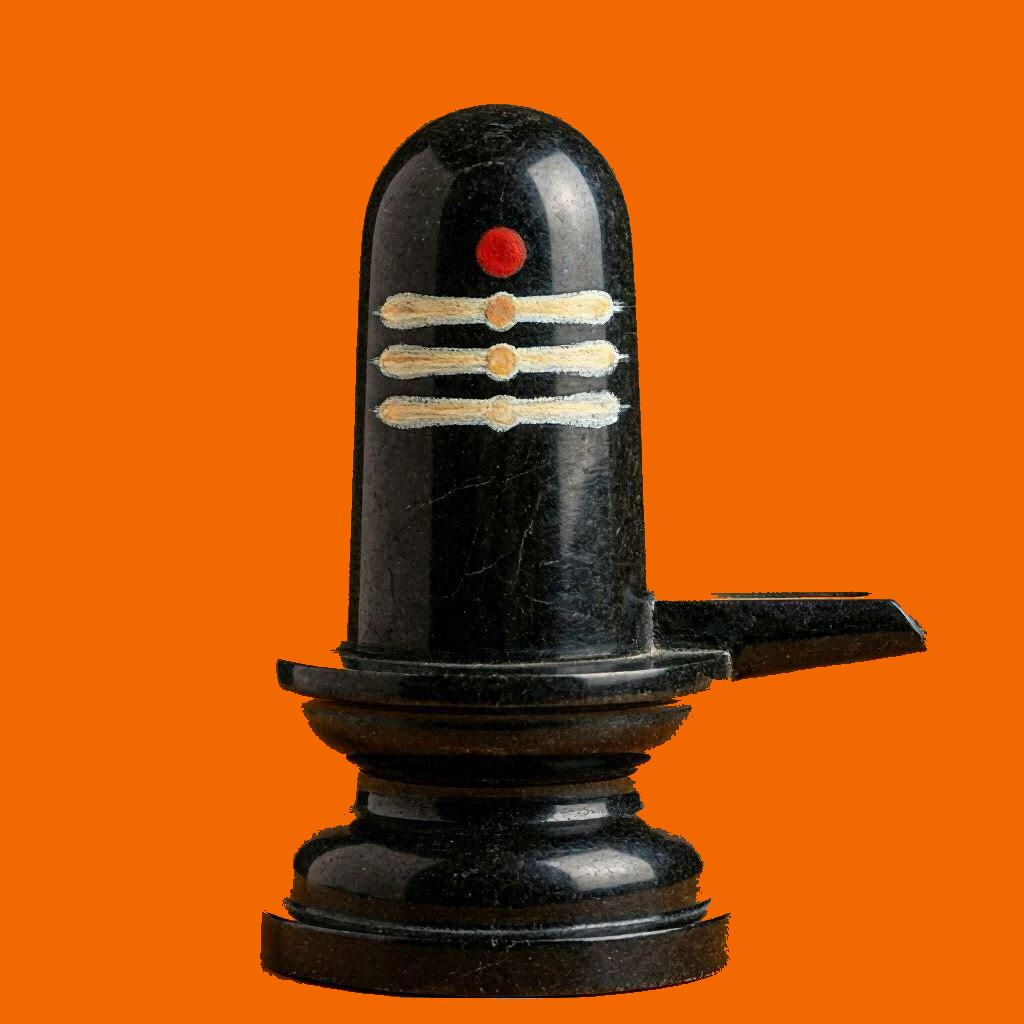
The opening verse of the Namakam
ॐ नमस्ते रुद्र मन्यव उतो त इषवे नमः। बाहुभ्यामुत ते नमः॥
In IAST:
Oṃ namaste Rudra manyava uto ta iṣave namaḥ, bāhubhyām-uta te namaḥ.
In English:
Om — salutations to your wrath, Rudra, and salutations to your arrow, and salutations also to your bow-arms.
The hymn opens not with praise of Rudra’s gentle aspects but with reverent namaskara to his wrath itself, his arrow, his bow-arms — the weapons by which he can destroy. This is theological. The Sri Rudram opens by acknowledging that Rudra is dangerous, and that the practitioner stands before the dangerous deity asking for grace. Only after this acknowledgment does the hymn proceed to the gentler aspects.
Structure of the Namakam
The eleven anuvakas (sections) of the Namakam each take a different register of Rudra-Shiva and bow systematically to him in that register:
| Anuvaka | Register |
|---|---|
| 1 | Rudra’s wrath and weapons — and the prayer that they be turned aside |
| 2 | Rudra as fierce, with many forms and many appellations |
| 3 | Rudra as the wild one, dweller in forests, granter of healing herbs |
| 4 | Rudra as the artisan, the worker in metals, the maker of vessels |
| 5 | Rudra as the dweller in caves, the slope-walker, the mountain-roamer |
| 6 | Rudra as the warrior, charioteer, ruler of armies |
| 7 | Rudra as the lord of cattle and beasts, the friend of all creatures |
| 8 | Rudra in every dwelling — house, road, field, ocean. The Namaḥ Śivāya verse. |
| 9 | Rudra as the all-pervading — in body, in elements, in directions |
| 10 | Rudra as healer, as physician, as remover of sickness |
| 11 | The final salutation, the petition for peace |
The eighth anuvaka is the most famous because it contains the namaḥ śivāya phrase that became the central Shaiva mantra. It begins:
नमः पार्याय चावार्याय च नमः प्रतरणाय चोत्तरणाय च।
A long catalogue of namaskaras to Rudra in every conceivable form of location, occupation, and station. Buried in this catalogue — almost casually — is the line that became the entire Shaiva tradition’s central mantra. The Vedic seer Vasishtha did not signpost it; it sits among hundreds of other namaskaras with no special emphasis. Tradition is what elevated it later.
Structure of the Chamakam
The Chamakam is the petition-half. Where the Namakam bows, the Chamakam asks. Its structure is simple: each line lists boons the practitioner requests, ending with the refrain ca me yajñena kalpantām — “and may these be granted to me through the sacrifice.”
The boons span every category of human need. The opening anuvaka asks for:
Food, intellect, vigour, longevity, the means of practice, energy, brilliance, peace.
The middle anuvakas extend the list to material goods (cattle, grain, gold, fields), social goods (family, descendants, friends), and ritual goods (the means of sacrifice itself — fuel, ghee, vessels). The closing anuvakas ask for the most subtle goods: the four ashramas (life-stages), the four purusharthas (life-goals — dharma, artha, kama, moksha), the intuition of the divine.
It is a complete inventory of what a person might want. By the end the chanter has asked for, in detail, everything a human life could require.
Why the two halves are recited together
Some traditions recite only the Namakam (the more devotional half) on ordinary occasions and add the Chamakam on special ritual days. Others recite both daily. The theological logic of pairing them:
- Namakam first establishes the relationship — the chanter recognises Rudra-Shiva and bows
- Chamakam then makes the petition — within the established relationship, the chanter asks
To petition without first bowing would be presumption. To bow without ever petitioning would be incompleteness — Rudra-Shiva, in the Vedic worldview, is the source of all worldly and spiritual goods, and to bow to that source without expressing what one needs from it is a kind of willed poverty. The Sri Rudram, as a complete unit, models the right relationship: deep reverence first, full request second.
The Rudrabhishekam ritual
The most elaborate temple use of the Sri Rudram is the Rudrabhishekam — the formal bathing of the Shiva linga while the full Sri Rudram is chanted. A trained priest pours water, milk, ghee, honey, curd, and panchamrita over the linga in a continuous stream for the duration of the hymn (about 45 minutes for one full cycle). The bathing is unbroken; the chanting is unbroken; the two are coordinated so that the abhishekam concludes with the final namaskara of the Namakam or the final boon of the Chamakam.
Major Shaiva temples — Kashi Vishwanath, Mahakaleshwar, Rameswaram, Tiruvannamalai, Chidambaram — perform Rudrabhishekam daily. On special occasions (Pradosham, Shravan Somvar, Maha Shivaratri) the abhishekam may be performed eleven times in succession (the Ekadasha Rudrabhishekam) or one hundred and eight times (the Atirudra Mahayajna, a ritual sometimes lasting days).
On the antiquity of the hymn
The Sri Rudram is one of the oldest extant religious texts in continuous oral recitation anywhere in the world. The Yajurveda was compiled in its present form by roughly 1000-800 BCE, and the Sri Rudram is one of its core hymns. Vedic priests have been chanting the same syllables in the same order with the same pitch-accents for somewhere between 2,800 and 3,200 years.
This is staggering. The hymn’s continuity across that timescale is maintained by a tradition of oral transmission so rigorous that variations in even a single phoneme would be (and are) detected and corrected. The Sri Rudram heard at a Shiva temple today is — within the limits of human oral transmission — the same Sri Rudram that was heard there three millennia ago.
The Namaḥ Śivāya that contemporary practitioners chant has been chanted, in that exact form, for that long. Most practitioners do not realise they are joining a chain of unbroken voices that long. The realisation, when it lands, tends to change one’s relationship to the practice.
On reciting it
For a serious practitioner who wants to approach the full Sri Rudram, the canonical path is:
- Hear it first. Recordings by established Vedic chanters (notably the Krishna Yajurveda lineage of Tamil Nadu and Karnataka) are widely available. Listen for several months before attempting recitation.
- Learn the swaras (pitch accents). Vedic Sanskrit uses three pitches (udatta, anudatta, svarita) that must be reproduced precisely. Most modern recitations preserve them; many household reciters of stotras do not. The Sri Rudram requires the swaras.
- Find a teacher. Self-study from text alone is not the traditional path. A Vedic-trained Brahmin priest, or a sustained connection to a Veda Pathashala, is the recommended source.
- Start with anuvaka 1 of the Namakam. The opening salutation alone is a complete practice. Add subsequent anuvakas one a month.
For a less ambitious practice, the first anuvaka of the Namakam (about 3 minutes) is a stand-alone short hymn that captures the essence of the larger work. Many household practitioners chant only the first anuvaka daily and recite the full Sri Rudram only on special occasions.
Practice
The Sri Rudram is the foundation. The Shaiva devotional tradition is built on top of it — Om Namah Shivaya, the Mahamrityunjaya Mantra, the Rudrashtakam, the Panchakshara Stotram, all later hymns trace their authority back to this Vedic source. To recite the Sri Rudram is to drink directly from the well; the other hymns are streams downstream.
For practitioners who can sustain the practice — who can find a teacher, learn the swaras, and make the 45-minute commitment several times a week — the Sri Rudram becomes one of the deepest practices available in the entire Indian devotional tradition. It does not, in our editorial view, have an equal among Shaiva hymns. It is the original.