The opening verse
ब्रह्ममुरारिसुरार्चितलिङ्गं निर्मलभासितशोभितलिङ्गम्। जन्मजदुःखविनाशकलिङ्गं तत्प्रणमामि सदाशिवलिङ्गम्॥
In IAST:
Brahma-Murāri-surārcita-liṅgaṃ nirmala-bhāsita-śobhita-liṅgam, janmaja-duḥkha-vināśaka-liṅgaṃ tat-praṇamāmi sadāśiva-liṅgam.
In English:
The Linga worshipped by Brahma, Vishnu, and the gods; the Linga adorned with stainless radiance; the Linga that destroys the sufferings born of birth — to that I bow, the eternal Shiva Linga.
The architecture of the hymn
The Lingashtakam is one of the most cleanly built short Shaiva hymns in the devotional canon. Its structure is rigorously consistent across all eight verses:
- Three descriptive lines, each ending in the word liṅga (or its case-inflected form liṅgam)
- A fourth line that is always identical: tat-praṇamāmi sadāśiva-liṅgam — “to that I bow, the eternal Shiva Linga”
The chanter does not need to remember a different closing each verse. The refrain is fixed. This is one of the things that makes the hymn so usable in temple ritual: a priest performing abhishekam can recite it without losing track of the ritual movements, and a beginner learning Sanskrit can master the closing line on day one and add the openings verse by verse.
What each verse praises
Each of the eight verses opens a different window onto the Linga:
| Verse | The Linga as |
|---|---|
| 1 | Worshipped by Brahma, Vishnu, the gods — adorned with stainless radiance — destroyer of birth-sorrow |
| 2 | Adorned with perfumes and sandal paste, offered jasmine and bilva by the wise |
| 3 | The Linga in whose worship the eight siddhis arise |
| 4 | Adorned with gold, with precious gems, in whose presence the serpent-king resides |
| 5 | Worshipped by the rishis, the gods, the asuras — beyond the play of the gunas |
| 6 | The Linga before which the eight forms of Shiva are seen |
| 7 | Worshipped by the wise, adorned with the rays of countless suns |
| 8 | The Linga before which all elements of creation bow |
By the eighth verse the chanter has seen the Linga as object of cosmic worship (verse 1), as adorned ritually (verses 2, 4, 7), as origin of yogic power (verse 3), as transcending the play of attributes (verses 5, 6), and as the silent presence at the centre of creation (verse 8). Eight angles, one Linga.
On the Linga itself
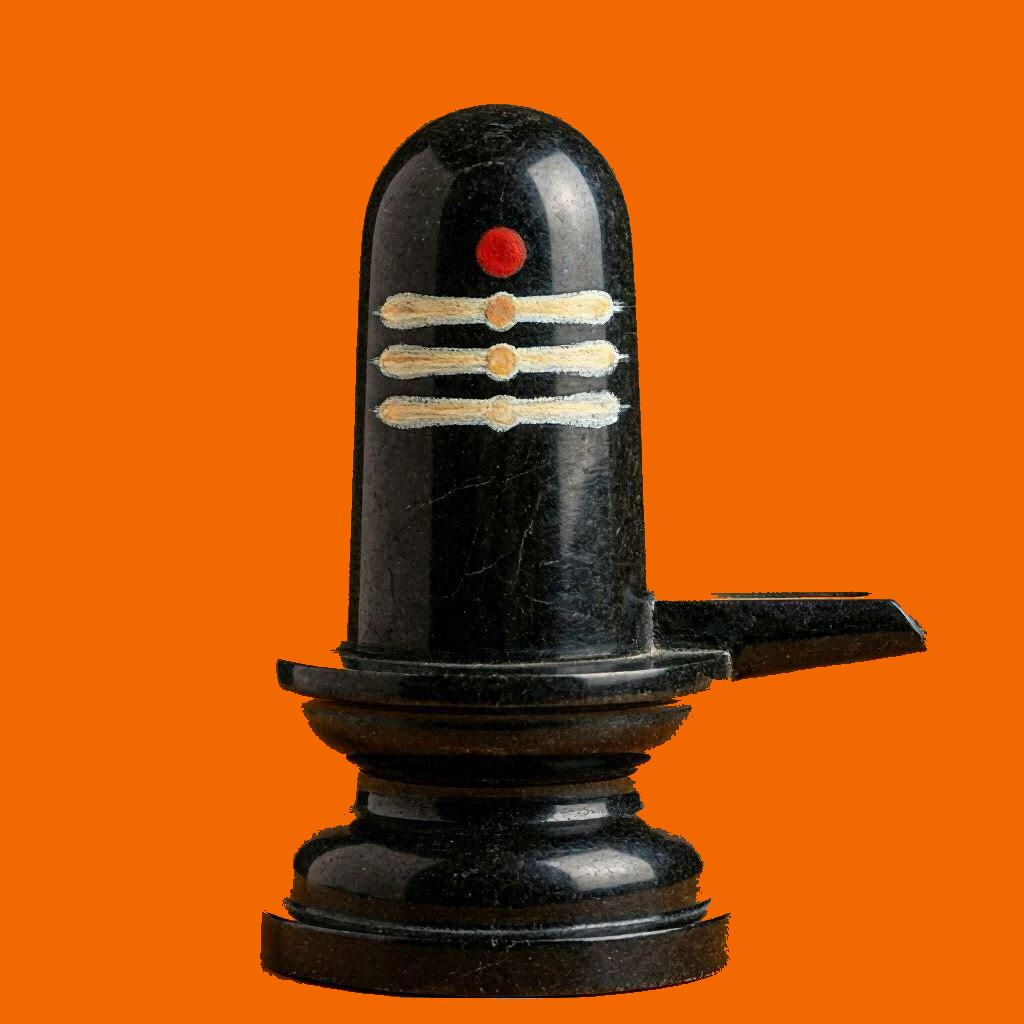
The Linga is not a phallic symbol in the way Western readers (following nineteenth-century European Indological reductions) have sometimes assumed. The Sanskrit word liṅga means “mark” or “sign” — the sign by which the formless makes itself known to the form-bound senses. In Shaiva metaphysics, Shiva-as-such is nirguna (beyond attribute), nirakara (beyond form), and therefore cannot be approached by the eyes. The Linga is the device by which the formless permits worship.
The vertical shaft and circular base are most often interpreted in Shaiva-Shakta theology as the union of Shiva and Shakti — purusha and prakriti, witnessing consciousness and creative dynamism — the two principles whose interpenetration is the cosmos. To worship the Linga is to worship not the masculine alone but the indissoluble pair: the witnessing Shiva and the dancing Shakti as one form.
The Lingashtakam never explicitly names this metaphysics. It simply bows, eight times, before what the metaphysics points at.
When to recite
The canonical occasions:
- Pradosham — the twilight window on the trayodashi tithi, twice each lunar month. The hymn fits exactly inside the window. This is the Lingashtakam’s primary use.
- Daily abhishekam — when the linga at one’s home altar or temple receives water, milk, or panchamrita, the Lingashtakam is the canonical hymn to recite during the pouring.
- Somvar — Mondays, often paired with the Bilvashtakam at the time of bilva offering.
- Maha Shivaratri — between the abhishekams of the four watches of the night.
- Before meditation — many practitioners use the hymn to enter the presence of a linga before a sitting practice.
Practice
The hymn rewards slow, even recitation. There is no virtuosity to display (unlike the Shiva Tandava); there is only the steady, eight-fold bowing.
Suggested approach for a new practitioner:
- Learn the refrain (tat-praṇamāmi sadāśiva-liṅgam) first. Repeat it thirty times. It will be in your body before the openings are in your head.
- Then learn verse one. Recite the whole verse for a week before adding verse two.
- By week eight, the full hymn is internal. Total practice time per day to reach that state: about ten minutes.
A useful pairing for daily Pradosham practice:
- Bilvashtakam first — as bilva leaves are offered
- Lingashtakam second — as abhishekam is performed
- Closing namaskara to Nandi
Three hymns, ten minutes, the Pradosham window honoured.