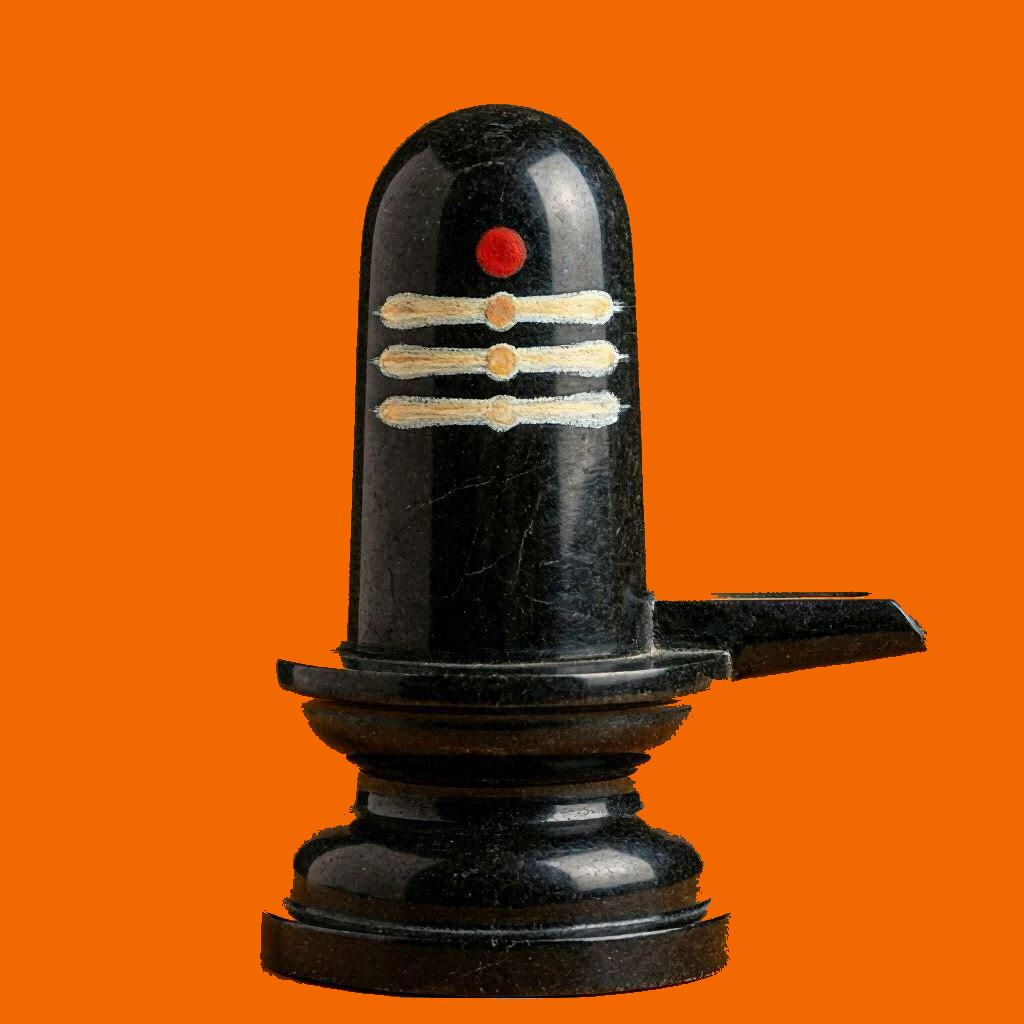
The opening verse
नमामीशमीशान निर्वाणरूपं विभुं व्यापकं ब्रह्मवेदस्वरूपम्। निजं निर्गुणं निर्विकल्पं निरीहं चिदाकाशमाकाशवासं भजेऽहम्॥
In IAST:
Namāmīśam-īśāna nirvāṇa-rūpaṃ vibhuṃ vyāpakaṃ brahma-veda-svarūpam, nijaṃ nirguṇaṃ nirvikalpaṃ nirīhaṃ cidākāśam-ākāśa-vāsaṃ bhaje’ham.
In plain English:
I bow to the Lord, the ruler, whose form is liberation itself — all-pervading, the very essence of Brahman and the Vedas. To him who is his own — beyond attribute, beyond division, beyond desire — to that consciousness-sky who dwells in the sky, to him I bow.
What the eight verses do
The Rudrashtakam is a tightly constructed sequence. Each verse takes one register of Shiva and develops it for four lines:
| Verse | Register |
|---|---|
| 1 | Transcendence — Shiva as liberation, as the consciousness-sky |
| 2 | Cosmic form — Shiva as Brahman, beyond mind and speech |
| 3 | Beauty — fair-skinned, beautifully limbed, the gentle moon-crested |
| 4 | The matted hair, crescent moon, third eye, serpent garland |
| 5 | The terrible aspect — Kapali, dispeller, destroyer of Tripura |
| 6 | Compassion — slayer of Andhaka, of Kama, granter of refuge |
| 7 | Yogis’ goal — adored by Brahma, Vishnu, and the wise |
| 8 | The closing prayer — without your grace, no rest |
Tulsidas does not flinch from Shiva’s terrible aspect (verse 5 names him as Kapali, the skull-bearer) but holds it in the same frame as his sweetness (verse 3, “the gentle moon-crested”). The hymn refuses the easy temptation to make Shiva safe. It also refuses to leave him terrifying. Eight verses, eight angles, one being.
The closing verse
The hymn closes with the practitioner’s confession:
न जानामि योगं जपं नैव पूजां नतोऽहं सदा सर्वदा शम्भु तुभ्यम्। जरा जन्म दुःखौघ तातप्यमानं प्रभो पाहि आपन्नमामीश शम्भो॥
I do not know yoga, japa, or worship. I bow always and forever to you, Shambhu. Burnt by the cycle of birth, old age, and sorrow — protect me, Lord, I am taking refuge. To you, Isha, Shambhu, I bow.
This is one of the most quoted devotional confessions in all of North Indian Shaiva-Vaishnava literature. The poet — the same poet who wrote the Ramcharitmanas, who had spent decades in disciplined practice — claims to know nothing of yoga, japa, or worship. The whole sophistication of the hymn dissolves into the simplicity of the refuge. The eight verses end where they should end: in the empty hands of the supplicant.
Source: where it sits in the Ramcharitmanas
The hymn is in the Uttarakanda — the last of the seven Kandas of the Ramcharitmanas. The frame is a conversation between Lomasha Rishi and the divine eagle Garuda, in which Lomasha resolves Garuda’s doubts about Rama by demonstrating the underlying unity of Rama and Shiva. The Rudrashtakam is the proof-by-recitation: Lomasha sings it, Shiva is pleased, and Garuda’s doubt is dissolved.
This framing matters. Tulsidas is not asking his Rama-devotee audience to shift allegiance; he is showing them that Rama-devotion includes Shiva-devotion. To recite the Rudrashtakam is, in his vision, to deepen one’s devotion to Rama, not to dilute it.
Metre and music
The hymn is composed in Bhujangaprayata — a metre of four feet, each foot being three short and three long syllables in the pattern la-ga-ga la-ga-ga la-ga-ga la-ga-ga (four yaganas). It has a serpentine, undulating gait — the metre’s name literally means “going like a serpent” — well suited to the imagery of Shiva’s serpent garland and matted hair. Sung at a steady devotional pace, the hymn takes about four minutes.
When to recite
The Rudrashtakam is one of the most flexible Shaiva hymns in daily practice:
- Pradosham — the canonical use. The eight verses fit cleanly inside the twilight window
- Somvar — Mondays, often after morning bath
- Shravan — many practitioners recite it daily through the month
- Maha Shivaratri — sung between the four watches of the night
- Daily morning practice — alone or after Om Namah Shivaya
The hymn pairs particularly well with the Mahamrityunjaya Mantra: the mantra for one’s own fear, the stotram for one’s own devotion. Many householders recite both, in sequence, every morning.
A small practice
For a beginner who finds the full Sanskrit forbidding: read one verse a day for eight days, slowly, with the English alongside. By day eight the language has begun to clarify itself, and the hymn is in the body. After that, full recitations in twenty minutes become possible. After a month, they take four.
The hymn rewards patience. Most who practice it for a year come to find that the closing verse — na jānāmi yogam — is the most honest thing they have ever said in Sanskrit.