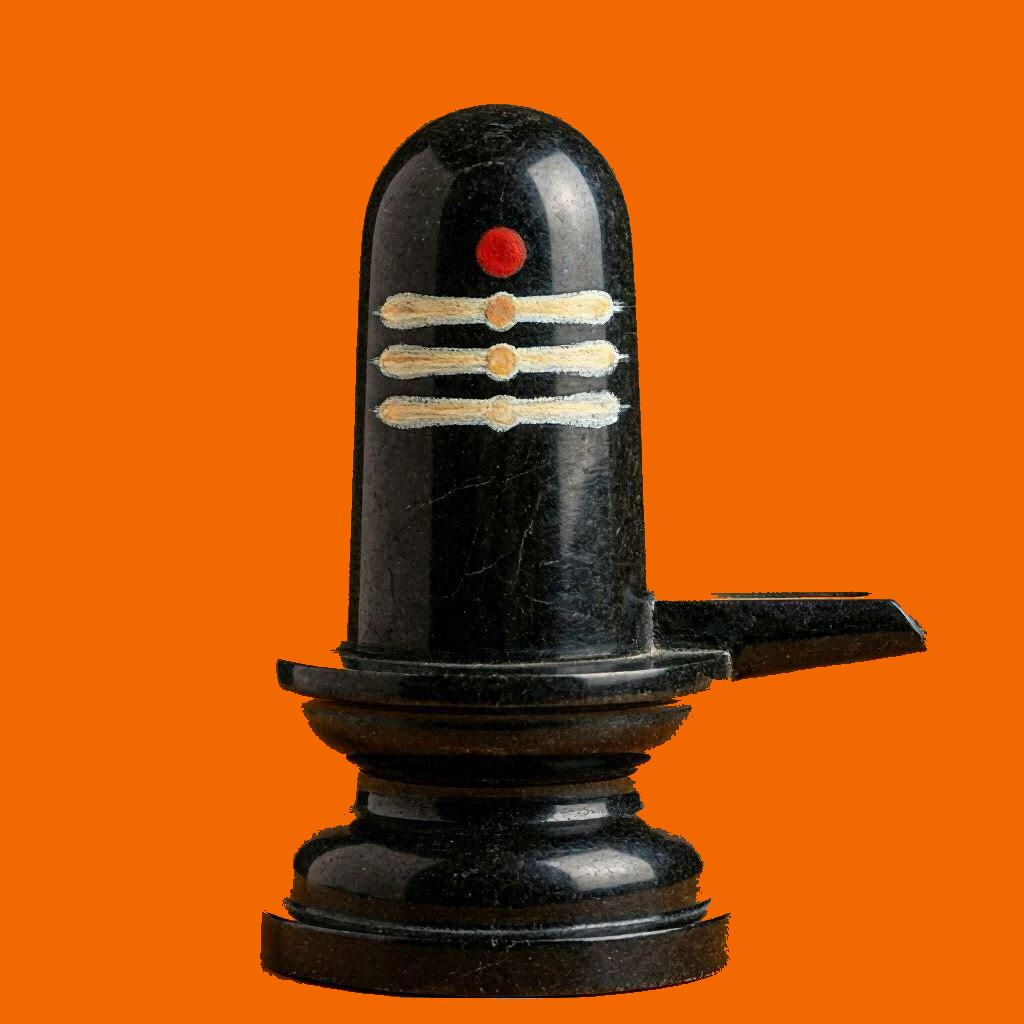
The opening doha
जय गणेश गिरिजा सुवन, मंगल मूल सुजान। कहत अयोध्या दास तुम, देहु अभय वरदान॥
The hymn opens not with Shiva himself but with a salutation to Ganesha — his elder son and the conventional opener of any North Indian devotional act. The doha (a two-line opening couplet) asks Ganesha for the boon of fearless recitation, and names “Ayodhya Das” as the composer in the same breath. (This in-text self-naming is part of why the attribution to Ayodhya Das circulates — though the name may itself be a pen-name or a later editorial addition.)
After the opening doha, the forty verses begin.
The structure of the forty verses
The Shiv Chalisa, like every well-formed Chalisa, is a layered hymn:
- Verses 1–8 — Iconographic praise. Shiva’s matted hair, the moon on his head, the Ganga falling through, the trident in his hand, the bull he rides, the serpents around his neck. Pure visual devotion.
- Verses 9–16 — The myths. Shiva drinking the poison at the Samudra Manthan (the churning of the ocean), Shiva burning Kama (the god of desire), Shiva slaying Tripura (the three demon-cities), Shiva’s marriage to Parvati after her tapasya.
- Verses 17–28 — Devotee stories. The Chalisa names specific devotees whom Shiva helped: Markandeya (the boy who chanted at the linga to conquer death), the sages of the Daruka forest, even (in some manuscript traditions) Ravana himself. The point is to establish that Shiva has a long history of responding to devotion, regardless of the devotee’s station.
- Verses 29–40 — The supplication. The chanter speaks in the first person, asking Shiva for the same protection that the named devotees received. The Chalisa shifts from third-person praise to first-person prayer, and the chanter steps into the lineage of all the devotees the earlier verses named.
The closing soratha (the final couplet) summarises the fruit of recitation and signs off.
Why this hymn took hold in North India
The Shiv Chalisa is, by some margin, the most-recited Shiva hymn in contemporary North Indian household practice. There are concrete reasons:
Language. Awadhi-Hindi rather than Sanskrit. A grandmother teaching her grandchild can do so without translation. The hymn does not require the mediation of a priest or a Sanskrit teacher.
Length. Forty verses fit cleanly into a household’s evening lamp-lighting ritual. Too short to feel slight, too long to feel onerous.
Form. The Chalisa genre was already familiar by the time the Shiv Chalisa entered general circulation — the Hanuman Chalisa had been a household fixture for nearly three centuries. A new Chalisa in the same form was immediately recognisable and easy to adopt.
Coverage. By naming both Shiva’s iconography (the hair, the Ganga, the trident) and the major Shaiva myths (Samudra Manthan, Kama-dahana, Tripura) in a single accessible hymn, the Chalisa effectively gives the householder a working knowledge of Shaiva tradition without requiring them to read the Shiva Purana. Many North Indian Hindus who could not name three Upanishads can recite all forty verses of the Shiv Chalisa from memory.
A note on the Chalisa genre
The Chalisa as a literary form is something of an under-appreciated genre. A well-formed Chalisa is not just a forty-verse hymn — it is a curriculum. The Hanuman Chalisa, for example, teaches the entire Hanuman story (the leap to Lanka, the burning of Lanka, the fetching of the Sanjeevani herb) in compressed mnemonic form. The Shiv Chalisa does the same for Shiva.
This is why Chalisas are taught to children. They are pedagogy as much as prayer. A child who learns the Shiv Chalisa at eight years old has, by recitation, absorbed the basic Shaiva narrative tradition without having to be lectured on it.
When to recite
The canonical use is evening lamp-lighting (diya jalana). In a North Indian Shaiva household:
- The evening lamp is lit at twilight
- The Shiv Chalisa is recited (about ten minutes)
- Aarti is performed and bhog (offering) is presented
- The household assembles briefly to share the prasad
Many householders also add the Chalisa to Somvar morning practice and to Pradosham. During Shravan, especially on Shravan Somvar (Mondays in the month of Shravan), the recitation is often expanded to multiple rounds.
On reciting it well
The hymn is in chaupai metre — four-line verses with a steady, rolling rhythm. It is not meant to be rushed. Most experienced reciters take about twelve to fifteen seconds per verse, which puts the full recitation at eight to ten minutes.
A useful frame for a beginner: do not try to memorise it all at once. Read the hymn aloud, with the printed text in hand, for two weeks. By the third week, the rhythm and the rhyme structure will have made about half of the verses already familiar; the rest will follow within a month. By the second month, the chanter can put the printed text aside.
On the tradition’s accuracy claims
A note of editorial honesty. Several lines of the Shiv Chalisa make claims about Shiva myths that compress or simplify the canonical Puranic accounts. The Samudra Manthan reference, the Tripura-burning reference, and the Markandeya story all appear in the Chalisa in highly abbreviated form. The abbreviation is fine for devotional practice. A reader who wants the full narrative should turn to the Shiva Purana, the Linga Purana, or (for Markandeya specifically) the Markandeya Purana. The Chalisa is a doorway, not a destination.
Practice
For a household just beginning a daily Shiva practice, the Shiv Chalisa is one of the best entry points available. It requires no Sanskrit, no prior Shaiva knowledge, and no specialised ritual apparatus — only the evening lamp, a printed text, and ten minutes. After a month it is in the body. After a year it has become the texture of the evening itself.
For a household already deep in Shaiva practice, the Chalisa retains its place as the daily evening anchor, with more demanding hymns (the Rudrashtakam, the Shiva Tandava, the Lingashtakam) layered on top for specific occasions.