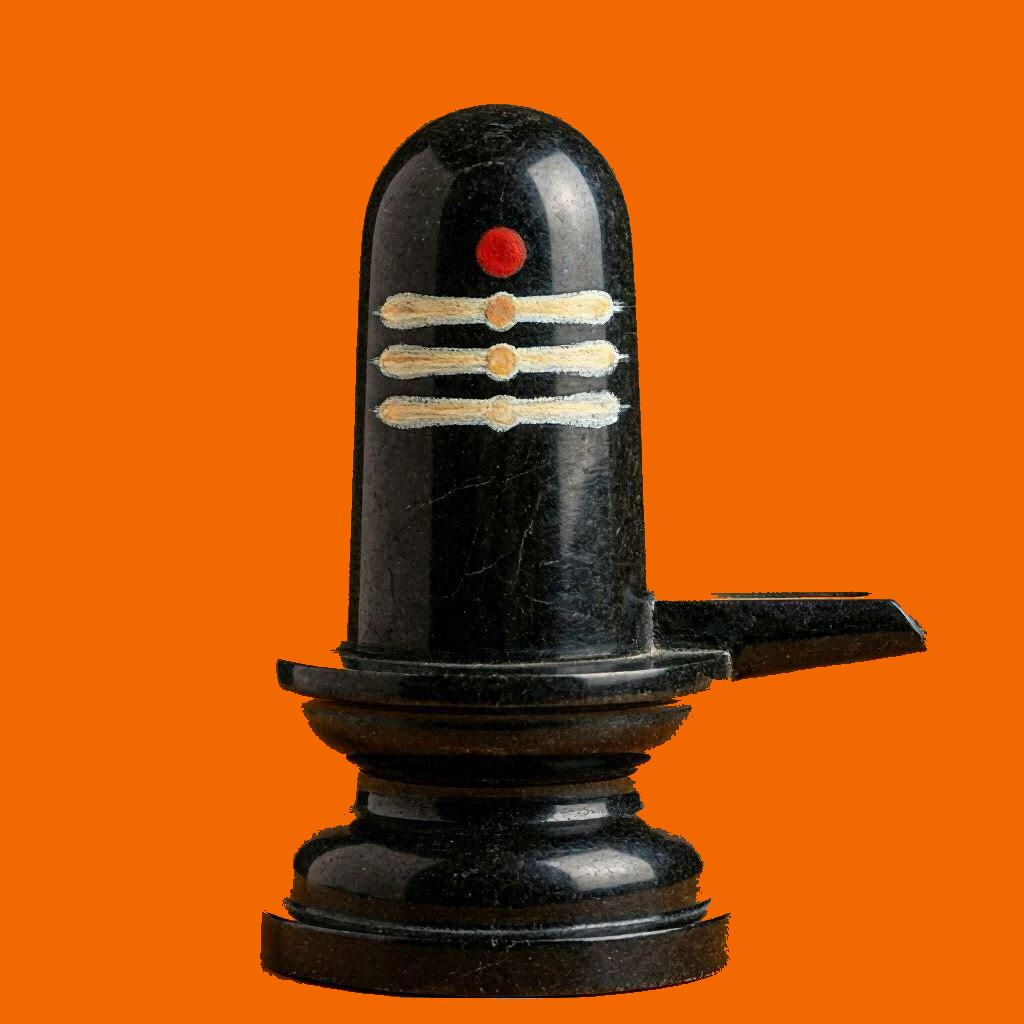
The opening verse
पशूनां पतिं पापनाशं परेशं गजेन्द्रस्य कृत्तिं वसानं वरेण्यम्। जटाजूटमध्ये स्फुरद्गाङ्गवारिं महादेवमेकं स्मरामि स्मरारिम्॥
In IAST:
Paśūnāṃ patiṃ pāpa-nāśaṃ pareśaṃ gajendrasya kṛttiṃ vasānaṃ vareṇyam, jaṭā-jūṭa-madhye sphurad-gāṅga-vāriṃ Mahādevam-ekaṃ smarāmi smarārim.
In English:
Lord of beings, destroyer of sin, supreme lord, wrapped in the elephant’s hide, foremost; in whose matted locks the Ganga’s waters shine — the one Mahadeva, slayer of Kama — I remember.
The Pashupati framing
Every verse of the Vedasara Shiva Stotram opens with Paśūnāṃ patiṃ — “lord of beings.” This is the hymn’s signature move. By repeating the Pashupati invocation nine times, Shankara is doing more than naming Shiva by an epithet; he is establishing the entire theological frame of the hymn.
The frame is this: every creature — every jīva, every bound soul — is a paśu. The word ordinarily means “animal” or “beast” but the Shaiva philosophical tradition extends it to all souls in bondage. A paśu is distinguished from a free being not by species but by bondage. The free beings (mukta) have released the knots; the bound beings (paśu) have not yet.
Shiva as Pashupati is therefore the lord of every bound soul — every creature in samsara, every reader of this page. The hymn is not addressing a deity who oversees livestock; it is addressing the deity who oversees the bondage itself, and who alone can release it.
This frame is what justifies the hymn’s title. The “essence of the Vedas” is the bondage-and-release teaching that the Vedas, the Upanishads, and the Brahmana literature collectively develop. Shankara is claiming that this entire teaching can be compressed into nine verses, each of which opens with the same recognition: that Shiva is the lord of the bound, and the bound include the one chanting.
What each verse names
| Verse | Shiva as |
|---|---|
| 1 | Lord of beings, destroyer of sin, supreme lord, slayer of Kama |
| 2 | Cause of the universe, beyond grasp by mind or speech, eternal |
| 3 | The trident-bearer, the moon-crested, the bull-rider |
| 4 | The blue-throated (Nilakantha — who drank the poison) |
| 5 | The destroyer of Tripura, the burner of the three demon-cities |
| 6 | The friend of Kubera, the granter of all wealth |
| 7 | The lord of Parvati, the father of Ganesha and Skanda |
| 8 | The bestower of moksha, the dissolver of karma |
| 9 | The closing benediction — the hymn’s fruit and dedication |
The progression moves from theological foundation (verses 1–2: the metaphysical Shiva) through iconographic specifics (verses 3–4) to the mythic deeds (verse 5: Tripura) and the social-cosmic functions (verses 6–7) to the soteriological promise (verse 8) and the closing seal (verse 9).
Nine verses, the entire arc.
Why this hymn is “the essence”
The claim of essence is large. To examine it, consider what a Shaiva practitioner would need to know to ground their devotion in Vedic authority:
- Shiva is the supreme deity (verses 1, 2) — established by the Sri Rudram, the Shvetashvatara Upanishad, the Rudra-Adhyaya
- Shiva is the iconographic deity with specific attributes (verses 3, 4) — the trident, the moon, the bull, the blue throat — established by the Puranas, especially the Shiva Purana
- Shiva acts in history through mythic deeds (verse 5) — Tripura, Andhaka, Kama — established by the epic and Puranic literature
- Shiva is embedded in social-cosmic relations (verses 6, 7) — the family, the friendships, the cosmic offices — established by the household and temple liturgical traditions
- Shiva is the source of liberation (verse 8) — the moksha-giver — established by the Upanishadic-Vedantic synthesis
Each of these is a major thread in Shaiva theology. Shankara takes one verse per thread. By the ninth verse the practitioner has been walked through the entire grounding apparatus of Shaiva devotion — in about four minutes of recitation.
This is what Shankara meant by “essence of the Vedas.” Not that the hymn literally quotes the Vedas (it does not), but that the hymn compresses the theological scope the Vedas establish into a recitable short form.
On Shankara’s larger pattern
The Vedasara Shiva Stotram fits Shankara’s larger pattern as a composer of short devotional hymns that double as philosophical compendia. Compare:
- The Panchakshara Stotram compresses the five-syllable mantra’s iconography into five verses
- The Nirvana Shatkam compresses Advaita identity into six verses
- The Dakshinamurti Stotram compresses the silent-guru teaching into ten verses
- The Vedasara Shiva Stotram compresses Vedic Shaiva theology into nine verses
Shankara had a particular gift for compression. He could take a tradition that would require years of textual study to master and produce a hymn that delivered the entire scope of the tradition in four to seven minutes of recitation. The Vedasara Shiva Stotram is one of his most explicit exercises in this compression.
On reciting it
The metre is Bhujangaprayata — the serpentine four-foot metre that also carries the Rudrashtakam and the Nirvana Shatkam. It is sweet, undulating, not difficult. The hymn recites cleanly in three to four minutes at moderate pace.
Three uses are most common:
As a daily standalone. The hymn fits in any morning practice without displacing the established hymns. Many practitioners recite it immediately after Om Namah Shivaya japa as a structural seal — the mantra anchors the heart, the Vedasara hymn anchors the head.
As a framing invocation before larger Shaiva ritual. The hymn’s “essence of the Vedas” character makes it appropriate as the opening recitation for a sustained puja or abhishekam.
As a teaching tool for explaining Shaiva theology to a beginner. The nine verses give a curriculum — the practitioner who has internalised the hymn has, by recitation, absorbed the structural map of Shaiva tradition.
Practice
For a beginner: read the English meaning slowly first. The Sanskrit vocabulary is dense with technical epithets (Pashupati, Vishvesha, Nilakantha, Tryambaka) that will not be familiar without prior reading. Once the epithets are known, the verses unfold easily.
Once the meaning is clear, recite slowly with a printed text for a week. The repeated opening (Paśūnāṃ patiṃ) and the steady metre will internalise the hymn within two to three weeks. By the end of a month, the full nine verses can be recited from memory in under four minutes.
For long-term practice, the Vedasara Shiva Stotram pairs particularly well with daily Om Namah Shivaya japa and a weekly recitation of the Sri Rudram (or an excerpt). The mantra carries the bhakti; the Vedasara carries the structure; the Sri Rudram carries the Vedic source. Together the three form a complete daily-to-weekly Shaiva discipline.